Astronomers using the XMM-Newton and Suzaku observatories have seen the predicted distortions of spacetime and are helping in a pioneering method to determine the properties of neutron stars.
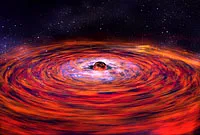
Illustration of a neutron star. Credit: NASA/ Dana Berry
These observatories have been used to observe three neutron stars, compact and very dense objects. Astronomers are using these objects as a laboratory to study how matter can be compacted under the most extreme pressure that nature can offer.
To achieve this, it is necessary to measure the diameter and masses of neutron stars with the greatest precision. In two current studies, one by XMM-Newton and another by Suzaku, astronomers have taken a big step forward.
With XMM-Newton, Sudip Bhattacharyya, from the Goddard Space Flight Center, and his colleague Tod Strohmayer, observed a binary system known as Serpens X-1, which contains a neutron star and a stellar companion. They studied the spectral line of the hot iron atoms that are swirling around a disk, just beyond the surface of the neutron star, at 40% of the speed of light.
Previous X-ray observations detected iron lines around neutron stars, but lacked the sensitivity to measure the shapes of the lines in detail.
Thanks to the large mirrors of XMM-Newton, Bhattacharyya and Strohmayer found that the iron lines are asymmetrically broadened by the extreme speed of the gas, which distorts the line due to the Doppler effect. The distortion of spacetime by the powerful gravity of the neutron star, an effect of Einstein's General Theory of Relativity, stretches the wavelength of the star's iron line.
"We have seen these asymmetric lines in many black holes, but this is the first confirmation that neutron stars can produce them too. It shows that the way neutron stars accrete material is not very different from black holes, and gives us a new tool to test Einstein's theory," says Strohmayer.
A group led by Edward Cackett and Jon Miller of the University of Michigan, which includes Bhattacharyya and Strohmayer, used Suzaku to study three binary neutron stars: Serpens X-1, GX 349+2, and 4U 1820-30. This team observed an almost identical iron line in Serpens X-1, confirming the previous result. They also detected similar lines in the other two systems.
"We are seeing the gas coming out just outside the surface of the neutron stars. And since the inner part of the disk obviously cannot orbit any closer to the star's surface, these measurements give us a maximum size for the diameter of the neutron star. These stars cannot be larger than between 29 and 33 km, results that agree with other types of measurements."
Knowing the size and mass of neutron stars allows physicists to describe the stiffness (or equation of state) of the matter packed into these dense objects.
The paper with the XMM-Newton results is titled "Evidence for a Broad Relativistic Iron Line from the Neutron Star Low Mass X-ray binary Serpens X-1," by Bhattacharyya and Strohmayer, and appeared in Astrophysical Journal Letters on August 1.
The Suzaku results have been submitted to the same publication and are titled "Relativistic Iron emission lines in neutron star low-mass X-ray binaries as probes of neutron star radii" by Cackett, J. Milleri, S. Bhattacharya, J. Grindlay, J. Homan, M. van der Klis, T. Strohmayer and R. Wijnands.
Notes:
XMM-Newton is an X-ray observatory of the European Space Agency (ESA). Suzaku is the fifth Japanese X-ray satellite. It was developed by the Institute of Space and Astronautical Science of the Japan Aerospace Exploration Agency (ISAS/JAXA) in collaboration with the American Goddard Space Flight Center and MIT.
Sources and related links
ESA press release