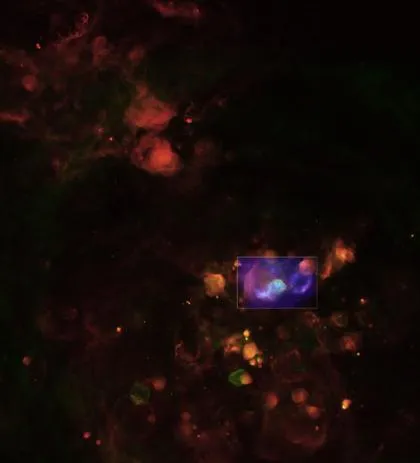
The Spitzer Space Telescope has detected enough water vapor to fill Earth's oceans five times over, inside a star-forming system. Astronomers say the water vapor is spilling out of the system's natal cloud and sticking to a dust disk where planets are thought to form.
"Wet" protostellar disk NGC 133. Credit: NASA/JPL-Caltech/R. A. Gutermuth (Harvard-Smithsonian CfA)
The observations provide the first direct view of how water, an essential ingredient for life as we know it, begins to make its way into planets, possibly even rocky ones like ours.
"For the first time we are seeing water being delivered to the region where planets probably form," says Dan Watson of the University of Rochester. Watson is the lead author of a paper about this young stellar system, which appears in the August 30 edition of Nature.
The system, called NGC 1333-IRAS 4B, is still growing inside a cold cocoon of gas and dust. Within this cocoon, circling the embryonic star, there is a growing, warm disk of planet-forming materials. The new data from Spitzer indicate that ice from the outer part of the cocoon is falling toward the forming star and vaporizing as it falls onto the disk.
"On Earth, water arrives in the form of icy asteroids and comets. Water also exists mostly as ice in the dense clouds that form stars," says Watson. "Now we have seen that water, falling as ice from the envelope of a young stellar system toward its disk, actually vaporizes upon arrival. This water vapor will later freeze again into asteroids and comets."
Water is abundant in our universe. It has been detected in the form of ice or gas around various types of stars, in interstellar space, and recently Spitzer obtained the first clear signs of water vapor on a hot gaseous planet outside our solar system, called HD 189733b.
In the new study, water also serves as an important tool for studying the planet-forming process in detail. By analyzing what is happening to the water in NGC 1333-IRAS 4B, astronomers are learning about its disk. For example, they calculate the density of the disk (at least 10 billion hydrogen molecules per cubic centimeter), its dimensions (a radius greater than the average distance between Earth and Pluto), and its temperature (170 Kelvin).
Watson and his colleagues studied 30 of the known young embryonic systems using Spitzer's infrared spectrograph, an instrument that splits infrared light into a spectrum of wavelengths, revealing the fingerprints of molecules. Of the 30 systems, only one was found with a large signature of water vapor. This vapor is detectable by Spitzer because when the ice hits the system's forming disk, it heats up rapidly and emits infrared light.
Why does only one of the 30 systems show signs of water? Astronomers say it is most likely because NGC 1333-IRAS 4B is in the right orientation for Spitzer to see its dense core. Furthermore, this particular stage of the star's life is short and difficult to capture.
The system in question is located in a star-forming region approximately 1000 light-years away toward the constellation Perseus.
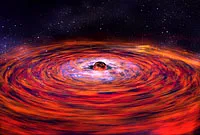
The diagram illustrates the primitive journeys of water in a young forming stellar system. Stars are born out of an icy cocoon of gas and dust. As the cocoon collapses under its own weight, an embryonic system forms at the center surrounded by a dense dust disk. The stellar embryo nourishes the disk for a few million years, while the material in the disk begins to clump together to form planets.
Spitzer was able to probe a crucial phase of this stellar evolution, the moment when the cocoon is falling toward the protoplanetary disk. Water vapor falling onto a disk orbiting a forming star was detected. This vapor began as ice in the outer part of the envelope but vaporized as it fell onto the disk.
By analyzing the water in the system, astronomers were also able to learn about other characteristics of the disk, such as its size, density, and temperature.
Sources and related links
- Press release on Spitzer
- Press release on EurekAlert
- More images at: Spitzer
- Paper: The development of a protoplanetary disk from its natal envelope, by Dan M. Watson, C. J. Bohac, C. Hull, William J. Forrest, E. Furlan, J. Najita, Nuria Calvet, Paola d'Alessio, Lee Hartmann, B. Sargent, Joel D. Green, Kyoung Hee Kim & J. R. Houck; doi:10.1038/nature06087