Observations from the Chandra X-ray Telescope of superbubbles in the Small Magellanic Cloud.
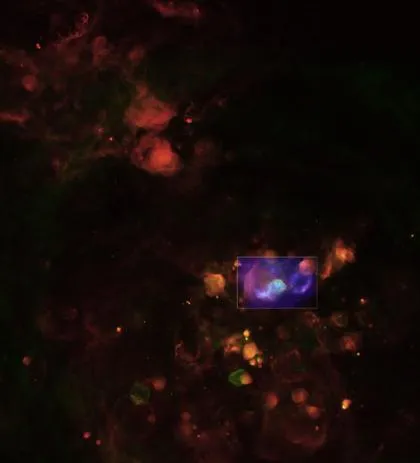
LHa115-N19 - Credit: NASA/CXC/UIUC/R.Williams et al.; Optical: NOAO/CTIO/MCELS coll.; Radio: ATCA/UIUC/R.Williams et al.
At a distance of only 200,000 light-years, the Small Magellanic Cloud (SMC) is one of the Milky Way's closest neighbors. With its millions of stars, the SMC offers astronomers the chance to study phenomena across the stellar life cycle. In several regions of the SMC, massive stars and supernovae are creating expansive envelopes of gas and dust. Evidence of these structures is found in optical (in red) and radio (in green) data in this composite image.
Astronomers used the Chandra X-ray Observatory to look at a particular region of gas and plasma clouds where stars are forming. This area, known as LHa115-N19 or shortened to N19, is filled with ionized hydrogen gas and is where many massive stars are expelling dust and gas through stellar winds. With the X-ray data combined with the other wavelengths, researchers find evidence for the formation of the so-called superbubble. Superbubbles form when smaller structures from individual stars and supernovae combine into one large cavity.
The Chandra data show evidence of three supernova explosions in this relatively small region. Furthermore, the observations suggest that each of these supernova remnants was caused by a similar process: the collapse of a very massive star. There are clues that these stars were members of the so-called OB association, a group of stars that formed from the same interstellar cloud.
Sources and related links
- Chandra press release
- Supernova superbubble caught forming