Astronomers using the GALEX space telescope have found an incredible star with a long comet-like tail.
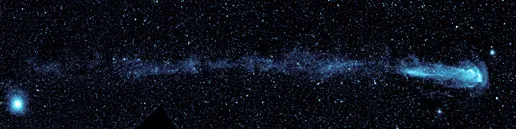
Mira and its long tail. Credit: NASA/JPL-Caltech
It is the star Mira and material coming out of it is forming a wake 13 light-years long or about 20 thousand times the distance between Pluto and the Sun, something never seen before.
Mira is an old star, a red giant that is losing large amounts of matter, scattering carbon, oxygen and other important elements that will form new stars.
"This is a completely new phenomenon for us and we are still in the process of understanding the physics involved," says Mark Seibert of the Carnegie Observatories.
"It was shocking when I first saw this completely unexpected tail behind a well-known star," adds Christopher Martin of the California Institute of Technology. Martin is the principal investigator of GALEX, Galaxy Evolution Explorer, and lead author of a new paper appearing today in Nature to announce the discovery.
Compared to other red giants, Mira is traveling unusually fast, possibly due to gravitational kicks from other stars. It is currently traveling at 130 kilometers per second. Along with Mira there is a small, distant companion that is thought to be a white dwarf. The pair, known as Mira A (the giant) and Mira B (the dwarf), slowly orbit each other as they travel together through the constellation Cetus about 350 light-years from Earth.
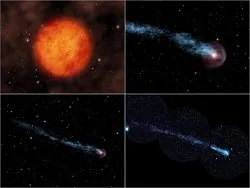
In addition to the tail, GALEX also discovered a bow shock, a kind of hot gas, in front of the star and two sinuous streams of material coming out of the star's ends. Astronomers think the hot gas in the bow shock is heating the gas coming out of the star, causing it to fluoresce in ultraviolet light. This material then swirls around the star, creating a turbulent wake-like wave. The process is similar to a motorboat leaving a wake in the water or a steam train producing a smoke trail.
The fact that Mira's tail is only seen in ultraviolet explains why other telescopes have not noticed it. GALEX is very sensitive to light of those wavelengths and has a large field of view, allowing it to scan the sky for unusual ultraviolet activity.
Putting the tail in context:
The image shows the length (top) and age (bottom) of Mira's long tail. Bottom left, Mira B, a companion of Mira, is seen.
The tail extends about 13 light-years and is made of gas and dust that has been slowly expelled over the last 30,000 years, with the oldest material at the end (left) and the newest near the star (right).
The graph allows putting the star's 30,000-year age in context with human history.
Sources and related links
- Note on Science@NASA
- Note on UniverseToday
- Note on NewScientist