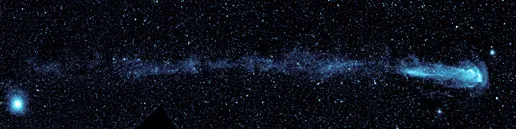
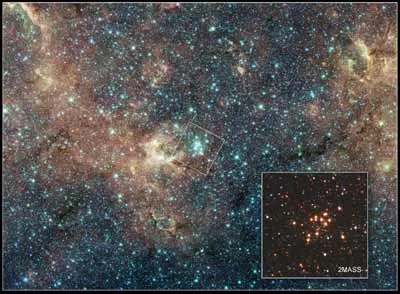
It was another of the public talks in Malargüe, during the last Annual Meeting of astronomers. Dr. Nolan Walborn is an astronomer and leads a group at the Space Telescope Science Institute, in addition to being a member of the scientific staff of said Institute, where he has worked for 24 years.
Walborn, who lived during his childhood and adolescence in our country, explained to the public different stages of the life of stars accompanied by magnificent images taken by the Hubble Space Telescope.
With an image from the space telescope that is in an orbit around the Earth at 600 km in height, Walborn began his talk by especially thanking the audience "since next door they are showing a film with George Clooney and Brad Pitt!"
"The Hubble telescope obtains very sharp images, much more than telescopes on the Earth's surface due to the non-interference of the atmosphere and also allows observations in different ranges of the electromagnetic spectrum; ultraviolet, for example, allows us to better see stars and nebulae since they emit a lot of information at that wavelength. In August 2008 there will be a maintenance and improvement mission and if it is successful, Hubble will last 10 more years."
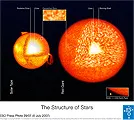
Dr. Walborn presented a graph showing a distribution of the different types of stars, called the HR Diagram. "First let's make sure we all know what a star is. They are clouds of gas and dust from the interstellar gas that for some reason these clouds tend to concentrate, by the laws of physics we know that when a cloud contracts the gravitational energy becomes thermal and the cloud heats up until its interior temperature reaches millions of degrees and a process of nuclear reactions begins that converts one element into another. These reactions produce energy, outward pressure and at some point it balances the inward pressure of gravity. That is called hydrostatic equilibrium. So, a star is a large mass of gas in equilibrium between the inward force of gravity and the pressure caused by the nuclear reaction, outward."
"Stars are burning fuel so they will have a finite life and that life and death will be different depending on the amount of matter it obtained when it was born."
In the diagram mentioned by Walborn, two basic properties of stars are seen: on one axis the luminosity, the total energy emitted by the star and on the other are the spectral types with their characteristic letters; these spectra are the light of the stars spread by a prism. If you have seen a rainbow it is a spectrum; it is a very important tool in astronomy because the patterns that this dispersed light gives in a spectrograph allow us to study characteristics of the stars and provides many details about the position, temperature, distance and other characteristics of the star. The spectral type correlates with the temperature of the star's surface and with the color of the star. The sun is a star of about 5000 degrees on its surface.
What we notice is that the stars are not scattered randomly, the vast majority are in a sequence on the HR diagram. It is now known that this sequence corresponds to stars when they are converting hydrogen into helium and this is 90% of the life stage of any star and that is why they are located in that sequence; it is also a mass sequence. Those located in the lower part of the diagram are faint and red and have one tenth of the mass of the sun; those located above can have between 40 and 50 solar masses.
The life of stars is shorter the more mass they have. The Sun has a life of 10 to 12 thousand million years and is about halfway through its life. The most massive stars last only two million years. A sequence of very faint stars is formed by the so-called white dwarfs.
Dr. Walborn specified the time it takes for light to reach us from the star and commented that light takes eight minutes to reach us from the Sun; "the closest star, Alpha Centauri is four light-years away from us and if it disappeared now we would know four years later. The Orion Nebula is 1500 light-years away from us.
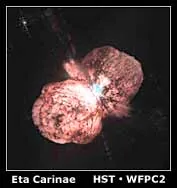
Eta Carina, a star that had an eruption in 1838, launched its material at a speed of 500 to 1500 km per second. This matter has a chemical composition that shows it has been processed in nuclear reactions inside the star and is now in an unstable state.
Nolan Walborn showed an image where a little arrow was seen pointing to a small star. "I can tell you for sure that that photo was taken before February 23, 1987 because that star died and became a supernova. It is the first supernova observed so close to Earth since the invention of the telescope and is of great interest to astronomers. Those who already existed for that day in 1987, should know that that night passed through your entire body 100,000 million neutrinos per square centimeter emitted by that star!
Neutrinos are massless particles that travel at the speed of light and most of that energy comes from supernovae. These neutrinos pass through matter almost without interacting and could be detected in the northern hemisphere in some water tanks specially designed for that. 19 were detected and it was one of the greatest triumphs of 20th century science, having recognized the presence of these particles that were predicted. It was possible to determine their origin and the direction from which they came.
See images at:
http://www.fcaglp.unlp.edu.ar/~extension/226/Walborn/
Sources and related links
- Bulletin of the La Plata Astronomical Observatory Year 6 Number 226, by Alejandra Sofía
- Eta Carinae Project