Using NASA's Swift satellite, astronomers from McGill University and Penn State have identified an object that is likely one of the closest neutron stars to Earth.
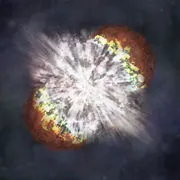
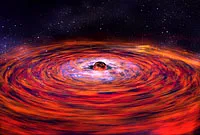
Illustration: Casey Reed, courtesy of Penn State University
The object, located in the constellation of Ursa Minor, was named Calvera after the villain in the movie "The Magnificent Seven". If confirmed, it would be one of the eight known isolated neutron stars - that is, a neutron star that is not associated with a supernova remnant, a binary companion, or radio pulsations.
"The seven previously known neutron stars are collectively known as 'The Magnificent Seven' in the community, so the name Calvera is a bit of a joke on our part," says Derek Fox of Penn State. A paper describing the research will be published in Astrophysical Journal.
The lead author, Robert Rutledge of McGill University, compared a catalog of 18,000 X-ray sources from the ROSAT satellite, which operated from 1990 to 1999, with catalogs of objects in visible light, infrared, and radio waves. He realized that the ROSAT source known as 1RXS J141256.0+792204 did not seem to have a counterpart at any other wavelength.
The group pointed Swift at the object in August 2006. The X-ray telescope showed that the source was still there and emitting the same amount of X-ray energy. The observations allowed the group to determine the object's position more precisely, and showed it was not associated with any other known object.
The team then performed observations of the object with the Gemini North Telescope in Hawaii. These observations, along with a short observation with the Chandra X-ray Observatory, showed that the object is not associated with any other object in the optical down to very faint magnitudes. The Chandra view saw the object as point-like, consistent with the neutron star interpretation.
According to Rutledge, there are no widely accepted alternative theories for objects like Calvera that are bright in X-rays and faint in visible light. Exactly what type of neutron star it is, however, remains a mystery. As Rutledge says, "Either Calvera is an unusual example of a known type of neutron star, or it is some new type, the first of its class."
The object's location high above the plane of our galaxy is part of the mystery. In all likelihood, the neutron star is the remnant of a star that lived in the disk of stars of our galaxy before exploding as a supernova. To reach its current position, it must have wandered some distance out of the disk. But exactly how much? "The best guess is that it is still close to its birthplace and therefore close to Earth," says Rutledge. If the interpretation is correct, the object is between 250 and 1000 light-years away, which would make Calvera one of the closest neutron stars.
The object could represent the tip of the iceberg of isolated neutron stars. There could be dozens out there, wandering alone.
Sources and related links
- Note on EurekAlert
- Note on Penn Univ.
- Press release from McGill