On September 18, 2006, astronomers observed the brightest supernova ever seen, called SN 2006gy, and were astonished to learn that it was intrinsically about 100 times brighter than typical supernovae.
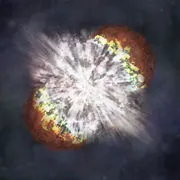
Illustration of SN 2006gy. Wikipedia
To explain this extreme power, its discoverers invoked an unusual argument based on the creation of pairs of matter and antimatter particles inside the massive star.
Now, Denis Leahy and Rachid Ouyed, both from the University of Calgary in Canada, have proposed an even more exotic scenario, the fantastically violent birth of an object called a quark star.
Quarks are subatomic particles that normally associate in groups of two—producing short-lived mesons, or three, producing protons and neutrons.
But some physicists say that when matter is crushed by extreme densities, a soup of individual quarks is established. One cubic centimeter of this new matter—dubbed 'strange' after one of the six types of quarks also called that—would weigh like a billion tons and have the unusual property of converting any ordinary matter it touches into more 'strange' matter, releasing energy in the process.
The energy released by converting a star's core to strange matter would cause an explosion called a "quark nova," which the authors argue has been observed for the first time in SN 2006gy.
For them, the event begins when a massive star expels its outer layers in an ordinary supernova explosion. In the process, the core collapses to become a dense object called a neutron star.
But the team argues that some neutron stars last a short time because their magnetic properties cause their spin rate to drop drastically. As the centrifugal force can no longer support the core, it collapses further into strange matter.
The transformation releases a tremendous amount of energy, ejecting the neutron star's outer layers into space at speeds close to that of light. The layers then collide with the debris from the original supernova, creating an intense glow sufficient to explain the observations of SN 2006gy.
Ouyed says that evidence for the "quark nova" scenario could be obtained by continuously monitoring what remained of SN 2006gy, which might show signs of rare elements with an atomic weight greater than 130. That could only be produced by that scenario, says the scientist.
Sources and related links
- Note in NewScientist
- Paper: Supernova SN2006gy as a first ever Quark Nova?
- Quark Stars, on Axxón
- Deep Space: Quark Stars, what they are.