Let's separate the astronomical wheat from the chaff.
In popularization contexts, two statements are often made:
1-In astronomy, we see the past.
2-Because of the above, it is likely that we observe stars that no longer exist.
Let's see how much truth these phrases possess.
1-Seeing the past: a matter of scale
It is true that we see the past. But not only in astronomy. Also in everyday life, since the speed of light is not infinite. However, in daily life it is not noticeable, because the distance that light travels from its emission/reflection (instant of emission, ide) to our eyes (instant of observation, ido) is small in relation to the speed of light. Therefore, the time difference between those two moments, ide-ido, is measured in units less than a second.
In astronomy, on the other hand, distances are much greater, and that is why the difference between those two instants is greater and the amount of time is measured in units of higher numerical value. The light we observe NOW from our Moon is light from the Sun that reflected off the natural satellite 1 second ago, since the Earth-Moon distance is almost 1 light-second. But everything else is farther away.
We can conclude that statement 1 is true, although it is also true that we always see the past, while the phrase seems to indicate that this only happens in astronomy. In any case, in astronomy, because it has larger distance scales (and therefore also time scales), it becomes more noticeable that we observe the past.
However, the following clarification is worth making: we see the past in one sense, but not in another. We observe the light that reaches our eyes now. The instant of observation (ido) is always present. Of course, there is a delay between the radiation reaching our eyes and that stimulus being interpreted by our brain. But we are talking about units much less than a second, so we can consider them in the present time.
The instant of emission (ide) is always past, but the instant of observation is always present. In astronomy or anything else.
2-Seeing stars that no longer exist
What was said in the previous point allows us to think that we may be observing now (ido) stars that no longer exist because their ide occurred at such a distance that the light has not yet finished traveling it. We have objective data as an example: Sanduleak 202, also known as Sanduleak -69° 202a, is the progenitor star of supernova SN1987A, in the Large Magellanic Cloud.
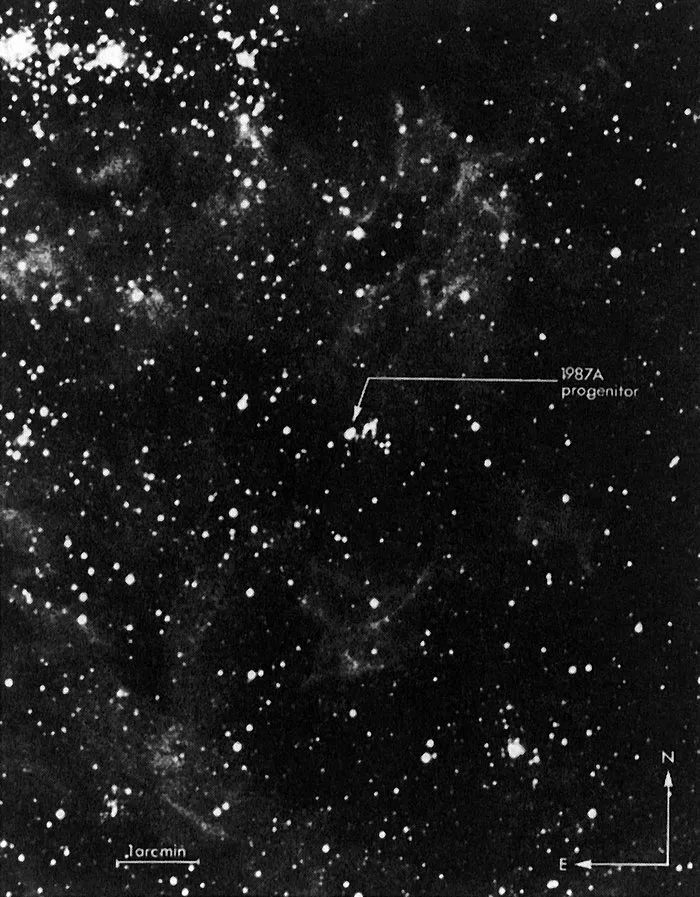
The light from the explosion was emitted (ide) 170 thousand years before its instant of observation (ido) in February 1987, since the distance to that galaxy is 170 thousand light-years.
However, let's think about this: with the naked eye, all the stars we see belong to the Milky Way. The Magellanic Clouds we can see with the naked eye as the nearby galaxies they are, but we cannot distinguish individual stars, I repeat, with the naked eye.
But if we limit ourselves to the naked-eye observation of stars, everything we observe is local, from our galaxy. The Milky Way is 100 thousand light-years in diameter and the Solar System is about 26 thousand light-years from the central bulge. That is, the greatest possible distance from the Solar System are stars from the farthest edge, about 74 thousand light-years away.
This simplification has this problem: the outer parts, the galaxy's halo does not end at 50 thousand light-years from the center, but extends almost halfway to Andromeda at more than 2.5 million light-years. In that sense, stars that belong to our galaxy can be found beyond 75 thousand light-years. Stars have been discovered at 1 million light-years from the galactic center, in the most distant outskirts of our galaxy's halo.
The stars that can cease to exist the fastest are the supergiants that exhaust their nuclear fuel in a few million years. But they make up less than 1% of the stars in the galaxy, while red dwarfs (class M) are 70% of the stellar population. These latter stars have equilibrium periods (main sequence) of several thousand million years. Our Sun, a star of spectral class G2, white-yellow, has a main sequence period of about 10 thousand million years. Class M stars are smaller and have longer equilibrium periods.
As a consequence of these data, it is possible, but very unlikely, to observe with the naked eye stars that have already disappeared, but whose light emitted before their collapse we can still observe, because they are very far away. Even those variable stars observed at almost 1 million light-years from the galactic center. In that case they were RR Lyrae type variable stars. The star that gives its name to that class of variables, RR Lyrae, is a star a little more luminous than our Sun, of class F. Variables of this type can be from class A to F. The largest, brightest stars, with the shortest equilibrium times are class O and class B stars. Their main sequence period ranges from 1 to 3 million years.
This is why, since that type of star is a very minor component of all the stars in the galaxy, and the rest have much longer equilibrium periods, it is unlikely that when observing the sky with the naked eye we are seeing a supergiant star that has already collapsed as a supernova. But it is not impossible, only that this will happen to us infrequently in relation to all the stars we can see.
When we finally learn of some supernova explosion that can be seen with the naked eye, it will not only be a unique spectacle, which occurs very rarely, but we could also say that we had observed the progenitor star before. And that we were seeing it even though it had already collapsed.
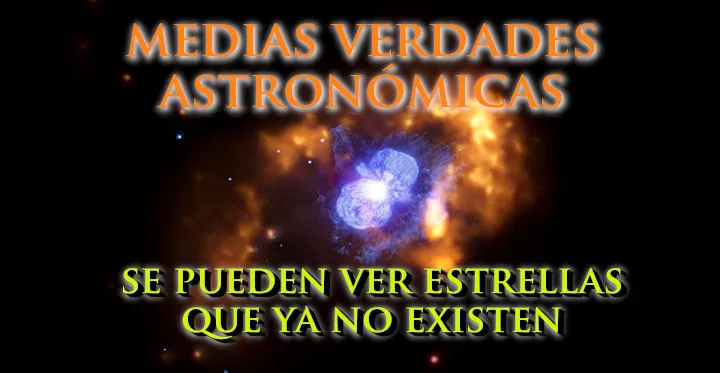
If we had to look for a candidate star, a good choice -especially for observers in the southern hemisphere, would be Eta Carinae: it is a binary system with an O star + an LBV (Luminous Blue Variable). It is thought to have been in equilibrium for almost 3 million years, so in the next hundred thousand years it could collapse gravitationally.
If we point our finger at the sky, the chance that we happen to point at a star with similar characteristics is more difficult than winning the lottery.
Getting it right is unlikely, but if you succeed, the prize -in the future- is an uncountable number of photons and a show...astronomical!☉
Sources and related links
- The star that exploded on February 23 in the Large Magellanic Cloud
https://www.eso.org/public/spain/images/eso8705b/ - Sanduleak -69° 202a
https://es.wikipedia.org/wiki/Sanduleak_-69%C2%B0_202a - Death of Stars
https://web.archive.org/web/20160416052013/http://physics.gmu.edu/~jevans/astr103/CourseNotes/ECText/ch18_txt.htm#18.5.2. - Astronomers find the most distant stars in our galaxy halfway to Andromeda
https://news.ucsc.edu/2023/01/milky-way-halo/
About the images
Credits: ESO
X-ray: NASA/CXC/GSFC/M.Corcoran et al.; Optical: NASA/STScI.