Although not as well known as Orion, the Corona Australis region (which contains the Coronet cluster) is one of the closest and most active star-forming regions.
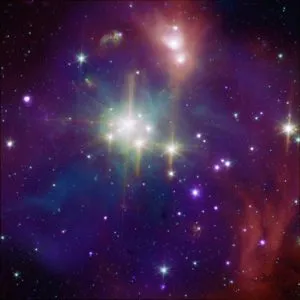
NASA/CXC/JPL-Caltech/CfA
At only 420 light-years away, Coronet is almost three times closer than the Orion Nebula.
The composite image shows Coronet in Chandra X-rays (in violet) and Spitzer infrared emission (orange, green and cyan). The Spitzer image shows young stars. In the Chandra data many of these young stars appear as blue objects, revealing high-energy X-rays and the amount of dust and gas in the region.
The Chandra data suggest that the X-rays from the very young stars are generated largely by magnetic activity in their outer atmospheres.
Because the cluster hosts young stars at different stages of life, astronomers can use these data to obtain details on how these adolescent stars evolve.
Sources and related links
- Note on Spitzer
- Note on Physorg