Cosmologists believe the early universe went through a period of expansion known as inflation, after the big bang, although they don't know exactly what caused it. Now, cosmologist Andrew Liddle from the University of Sussex, Great Britain, and his colleagues say a single particle could be responsible for both inflation and the dark energy that has been puzzling astronomers.
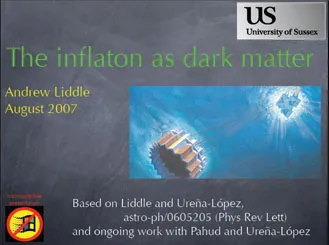
"We have these two mysteries that we don't really understand, so we thought, why not put them together to reduce the problem? It's so simple that at first we worried it was ridiculous," comments the scientist.
The theory of Liddle depends on the notion suggested by other cosmologists that inflation is caused by a hypothetical particle, the inflaton. "The inflaton has strange pressure properties that we don't see in everyday particles. For example, as they are created in the early universe, they push space, forcing the expansion," explains Liddle.
Standard thinking assumes that inflatons would have decayed into normal particles after inflation, in the first fraction of a second after the big bang. However, Liddle and his colleagues realized that if some inflaton particles survived after the intense expansion, their mass would have become important in attracting neighboring matter.
"In the late stages of the inflation and then forever, the expansion rate has decreased so the mass of the particles has become important and they would behave like dark matter particles exhibiting gravitational attraction," he explains.
However, the problem lies in explaining why most of the inflatons disappeared and only some survived.
"If inflatons can interact with normal particles, even very weakly, as is usually assumed, they should decay easily upon colliding with any particle.
To solve this, Liddle suggests that inflatons only decay when they collide with other inflatons, annihilating both. His calculations show that while most inflatons would indeed have annihilated, a few would have escaped.
Finding evidence for the theory will be difficult, however. Since Liddle's inflatons do not interact with normal matter, as the scientist explains, they will not show up in direct dark matter searches.
Since inflatons are very dispersed now, there is a small chance they will come into contact. But if that happened, high-energy radiation would be created, adds Liddle, who presented the work at the conference COSMO 07 in the University of Sussex in August.
Sources and related links
- Note in NewScientist
- Paper: "Inflation, dark matter and dark energy in the string landscape", by Andrew R Liddle, L Arturo and Ureña-López in Physical Review Letters