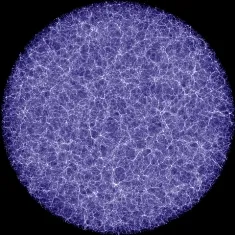
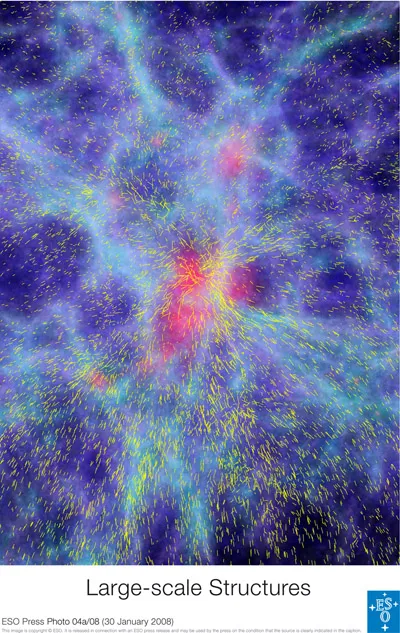
Three-quarters of our Universe is made of a rare, gravitationally repulsive substance that was only discovered 10 years ago: dark energy.
This month, in Physics World, Eric Linder and Saul Perlmutter, both from the University of California, Berkeley, reveal how little we know about this energy and describe what advances in our knowledge we can expect in the next decade from a series of planned space missions.
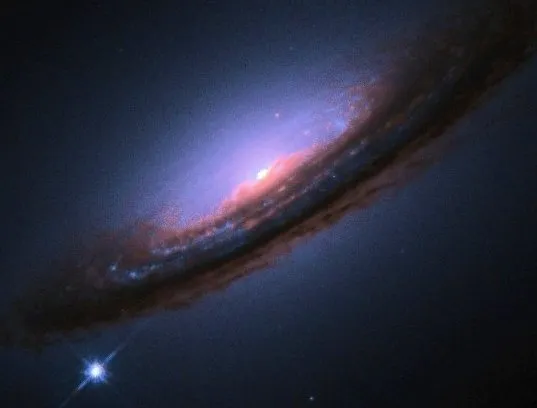
Perlmutter was one of the leaders of two separate teams of astrophysicists who concluded, by observing distant supernovae, that cosmic expansion was accelerating and not the other way around, as was assumed due to the influence of gravity.
The discovery led to the creation of the "concordance model" of the Universe, which states that 75% of our Universe is made of dark energy, 21% of dark matter - another substance not much is known about - and a remaining 4% of baryonic matter, which we do understand(*). The most conventional explanation is that dark energy is a kind of "cosmological constant" arising from the fact that empty space is not empty.
Since the first evidence of the acceleration of the Universe was made public in 1998, astrophysicists have provided additional evidence and made advances in measurement methods.
Galaxies and the cosmic background may hold significant clues. Equipment that can make better comparisons between galaxies and investigate temperature fluctuations in the cosmic microwave background is becoming possible. And methods for observing supernovae are being improved.
The scientists say: "The field of dark energy is very young and we have a long and exciting period of exploration ahead before it matures."
The December issue also includes a report by Robert P. Crease, historian at Brookhaven National Laboratory, on the difficulty of deciding who should get credit for the discovery of the acceleration of the Universe and comments by Lawrence M. Krauss, director of the Center for Education and Research in Cosmology and Astrophysics at Case Western Reserve University, on the possibility that we may never be able to say whether dark energy is a cosmological constant.
In addition, the issue will include:
50 years on: why physicists still love the Fortran programming language
Christmas books: a review of the best physics books for the holidays.
Sources and related links
- PhysicsWorld
- Note on EurekAlert
- The adventure of the Universe
- Image: Cover of PhysicsWorld, December 2007
- Special from HubbleSite Discoveries: Dark Energy
- (*)Note: In reality, the existence of baryonic dark matter is also assumed, that is, known matter that does not shine, like brown dwarfs.
Related notes