The average brightness of stellar explosions that astronomers rely on to measure dark energy—the mysterious force that would be responsible for the acceleration of the universe's expansion—may have changed over time, according to a new study.
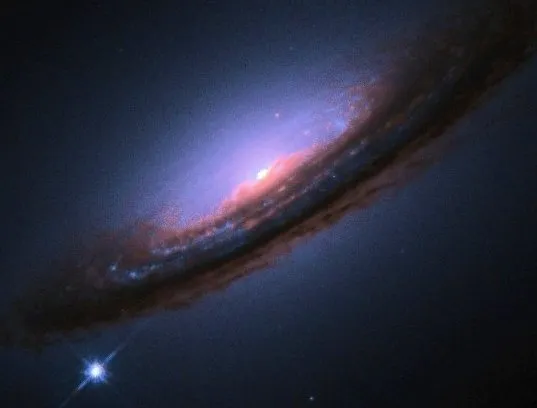
SN 1994D, a Type Ia supernova in galaxy NGC 4526
The authors say that uncertainties in measuring brightness could steer future measurements of dark energy in unpredictable ways.
To measure the expansion of the universe and discern the effects of dark energy, scientists rely on explosions called Type Ia Supernovae, which are thought to be the signs of the deaths of white dwarf stars.
These explosions can vary in brightness, but the brightness is related to how long they last. This means astronomers can theoretically distinguish between bursts that are bright but distant from those that are faint but close, allowing them to use them as standard candles whose brightness can be used to estimate astronomical distances.
But even knowing that the brightness of these supernovae can vary, astronomers assume that the overall rate of these bursts remains constant throughout the history of the universe. Now, a new study led by Andrew Howell of the University of Toronto suggests that explosions in the early universe were brighter on average than those occurring today, casting doubt on their use for measuring distances.
The team studied data from the Supernova Legacy Survey and the Higher z Supernova Search. They found that the brightest supernovae—which last longer than the faint ones—were more common in the past of the universe than today, a discovery that could support the hypothesis that there are multiple ways to create the explosions.
The researchers calculated that supernovae were, on average, 12% brighter 8 billion years ago than they are now.
The effect is not large enough to question the existence of dark energy. But it suggests that the corrections that have been used in the past to calculate the intrinsic brightness of supernovae from their duration could limit the precision of future studies.
That could seriously hinder the cosmological understanding of dark energy, since high-precision observations are necessary to find out if the strength of dark energy has changed over time, key to determining whether it is a constant property of space itself or a variable energy field.
Adam Riess of the Space Telescope Science Institute, who led one of the two teams that independently discovered dark energy in 1998 using supernovae, says that the change in the average brightness of supernovae could affect dark energy measurements. But only if the corrections already in use are not correct. And he adds that, with enough supernovae, one can make separate calculations using the bright ones or the faint ones. If the results agree, it would be safe to conclude that the corrections are working properly.
Alternative methods of measuring dark energy—such as the large-scale observation of the distribution of galaxies in space—could provide an independent test of supernova studies.
The reason why there were more Type Ia supernovae in the past remains a mystery. But a clue comes from observations showing that the bright ones seem to occur more frequently when stars form at a high rate, and the stellar birth rate was high in the early universe.
Sources and related links
- Note in NewScientist
- Paper:The Astrophysical Journal Letters (vol 667, p 37)