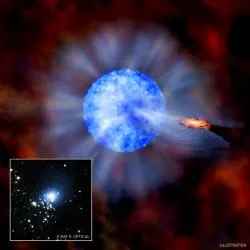
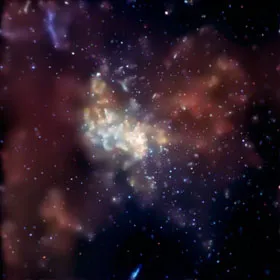
The song that says, "All we are is dust in the wind", might have some cosmic truth. New discoveries from the Spitzer Space Telescope suggest that space dust was manufactured in large quantities in the winds of black holes that populated the early universe.
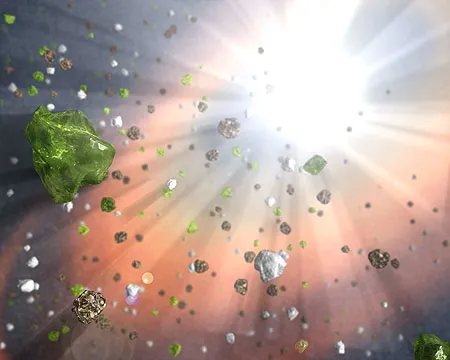
The discoveries are a significant clue in an unsolved mystery: where did all the dust in the early universe originate?
"We were surprised to find what appears to be recently made dust in the winds blowing away from supermassive black holes," says Ciska Markwick-Kemper of the University of Manchester, England, author of a new paper that will appear in an upcoming issue of Astrophysical Journal Letters.
Space dust is essential for the formation of planets, stars, galaxies and even life as we know it. The dust in our corner of the universe was generated by dying stars. But, when the universe was less than a tenth of its current age of 13.7 billion years, stars like our Sun had not had enough time to die and create dust.
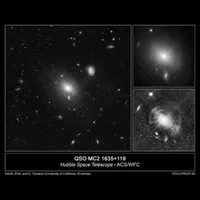
Theorists postulated that short-lived massive stars, exploding as supernovae, would be the source of the mysterious dust, while others postulated that quasars would be the contributors. A quasar consists of a supermassive black hole surrounded by dust that feeds it. Theoretically, dust can form in the outer region of the winds that slowly blow away from that doughnut-shaped cloud.
Markwick-Kemper and her team decided to investigate the quasar called PG2112+059, located at the center of a galaxy about 8 billion light-years away. Although it is not located in the early universe, it is an accessible target to elucidate whether quasars can make dust. The team used Spitzer's infrared spectrograph to search for signs of various minerals.
They found a mixture of ingredients like those that form glass, sand, marble and even rubies and sapphires. While the mineral that constitutes glass was expected, the others were a surprise. Why? Those minerals are not typically detected floating around galaxies, suggesting they could have been recently formed in the quasar's outgoing winds.
For example, the ingredient that forms sand, crystalline silica, does not survive long free in space. Stellar radiation converts the mineral into an amorphous state.
Of course, the case is not closed. More quasars are expected to be studied to obtain greater evidence. Furthermore, according to the astronomers, quasars may not be the only source of dust. "Supernovae could have been more important in creating dust in some environments and quasars in others."
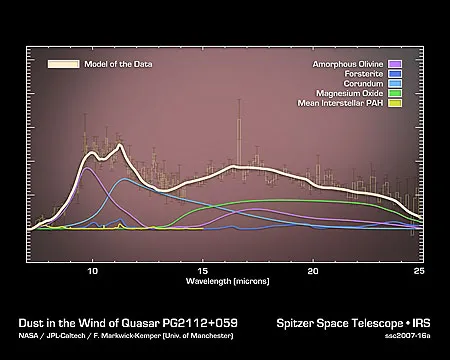
Chart with the minerals found in called PG2112+059.
NASA/JPL-Caltech/F. Markwick-Kemper (University of Manchester)
Sources and related links
- Press release on Spitzer
- Note on Physorg