"Textures" would be remnant defects from the Big Bang and were proposed more than a decade ago.
Scientists from the Institute of Physics of Cantabria (IFCA) and the University of Cambridge may have discovered an example of a cosmic defect known as a "texture". If the discovery, reported today in Science, is confirmed, it will help understand how the Universe evolved after the Big Bang.
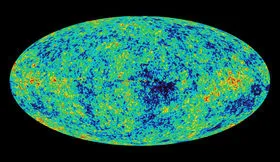
WMAP image of the cosmic microwave background radiation
Textures are defects in the structure of the vacuum left over from the hot early Universe. Professor Neil Turok showed how textures would form in the 1990s, noting that some could survive the Big Bang and could be visible in the current Universe. These textures could be observed by the hot and cold spots they create in the cosmic microwave background radiation (CMB) that fills the Universe and was released in the Big Bang 14 billion years ago.
The Big Bang theory proposes that the cosmos began with a very high density, a state of high temperature, cooling as it expanded. In the hot early Universe, physicists believe that different types of elementary particles (like the quark from which larger particles are created) behaved identically. As the Universe cooled, the vacuum changed and the symmetry between particles was broken, in a phase transition analogous to the freezing of water.
Just as misalignments in the crystalline structure of ice lead to defects, misalignments in the breaking of symmetry form cosmic defects. Textures are one type of defect.
Professor Turok provides the following analogy: "Imagine a large group of people standing. For any person, the group looks almost the same in all directions. Now tell them to lie down. People will tend to lie down in the same direction as their neighbors, but over large distances the chosen direction will vary. In some places, people could not decide which is the best direction to lie down: if everyone lies down pointing directly at you, you become a defect in the symmetry, a texture".
Textures are believed to collapse on progressively larger scales, creating intense energy and gravitational potential. This creates hot or cold areas, like the cold spot in the Galactic Southern Hemisphere discovered in 2004 (*).
Marcos Cruz and his colleagues, Dr. Patricio Vielva and Professor Enrique Martínez González, pursued numerous possibilities for the existence of the cold spot. In particular, they explored especially the possibility of it being due to systematic effects, background contamination from our own galaxy, or due to the scattering of the cosmic microwave background radiation by large galaxy clusters.
Each time they reached the same conclusion: there are no convincing arguments for any of these possibilities. They thought of the hypothesis that there would be a texture and with the assistance of Dr. Mike Hobson, a member of the astrophysics group at the Cavendish Laboratory in Cambridge, and Professor Turok, they were able to examine that possibility in detail.
Turok performed large-scale simulations using COSMOS, the Cambridge supercomputer, to accurately compare the theory with the event. Hobson weighed the relative possibilities of the cold spot being due to a texture rather than an extreme statistical fluctuation. The researchers concluded that the texture hypothesis is the most plausible for the cold spot but know that additional tests are required.
"The possibility is very exciting. If it is a texture, it will revolutionize our understanding of how the fundamental symmetries between particles and forces were broken as the Universe emerged from the Big Bang. The current data is suggestive but not complete. There are a number of tests that can be done with future data. It is a testable hypothesis and we will have the answer in the next decade," says Turok.
"The prominent cold region in the cosmic microwave background image taken by the WMAP satellite is a puzzling element that has attracted the attention of the cosmology community, but has not been convincingly explained. Our work investigates the exciting possibility that the cold spot is due to the presence of a cosmic texture; some current physical theories predict that textures are produced as the Universe evolves, but they have never been observed. Somewhat to our surprise, we found that the cold region and, indeed, the background radiation across the whole sky are consistent with the texture model. Although the data is incomplete, we suggest future observations that should be able to test our hypothesis definitively. If it is proven that the cold spot is indeed a texture it will completely change our view of how the Universe evolved after the Big Bang," concludes Hobson.
Sources and related links
- Note in EurekAlert
- Press release from U. of Cambridge
- (*) See also "Encuentan un enorme agujero en el Universo"