They were discovered inside dusty galaxies billions of light-years away.
The massive black holes, discovered by the Spitzer and Chandra space telescopes, represent a large portion of the population of "missing" black holes. Their discovery implies that there were hundreds of millions of additional black holes growing in the early Universe, more than double the total known amount at that distance.
NASA/JPL-Caltech/Commissariat a l'Energie Atomique
"Active, supermassive black holes were everywhere in the early Universe," says Mark Dickinson of the National Optical Astronomy Observatory in Arizona. "We had seen the tip of the iceberg in our search for these objects. Now, we can see the iceberg itself." Dickinson is a coauthor, along with Emanuele Daddi, of two new papers that will appear in the November 10 edition of Astrophysical Journal.
The discoveries are also direct evidence that most, if not all, massive galaxies in the distant Universe spent their youth creating monstrous black holes in their nuclei.
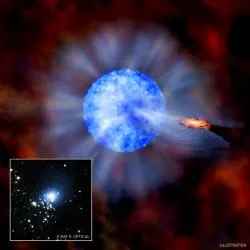
For decades, a large population of active black holes was considered "missing." These objects belong to a class of black holes called quasars. A quasar consists of a cloud of gas (shaped like a donut) that surrounds and feeds a forming supermassive black hole. As they are devoured, the gas and dust heat up and emit X-rays. These rays can be detected but usually the quasars themselves are not seen because they are blocked from our view by dust and gas.
"We knew from other studies over the last 30 years that there must be more quasars in the Universe, but we didn't know where to look for them, until now," says Daddi.
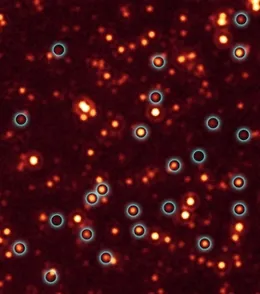
Daddi and his team initially studied 1000 massive galaxies busy creating stars and thought to lack quasars. The galaxies have a mass similar to the Milky Way, but are irregular in shape. At a distance of between 9 and 11 billion light-years, they existed when the Universe was in its adolescence, between 2.5 and 4.5 billion years old.
When astronomers spied more closely at the galaxies with Spitzer's infrared gaze, they noticed that about 200 galaxies generated an unusual amount of infrared light. X-ray data from Chandra and a technique called "stacking" revealed that the galaxies were hiding quasars inside. Scientists think the quasars heated the dust in their clouds, releasing the excess in infrared.
The new discoveries help answer fundamental questions about how massive galaxies evolved.
The observations suggest that galactic collisions might not play as important a role in evolution as previously thought.
Consistent results were recently obtained by Fabrizio Fiore of the Rome Observatory and his team. Their results will appear in the January 1, 2008 edition of Astrophysical Journal.
Sources and related links
- Note on Spitzer
- Note on Physorg
- Note on JPL