A mirror placed aboard a balloon might sound like something out of a fairy tale but, in reality, it is a scientific project that will reveal many answers about the sources of high-energy X-rays.
NASA
When Alice passed through the looking-glass, a completely new world was revealed to her —beetles with bad attitudes, Tweedledum and Tweedledee, smiling cats, talking tiger-lilies, and much more.
Mirrors also have special powers in the real world, especially in the hands of an astronomer. In fact, modern astronomy depends on mirrors. Almost all telescopes use a mirror, and sometimes many, to capture and guide starlight to some supersensitive digital detector where an impressive image can be formed. Without mirrors it would be almost impossible to study the universe.
For an astronomer dedicated to the study of X-rays it is a bit more complicated. "The X-ray light we use to study the universe has so much energy it could pass right through a common mirror," laments Brian Ramsey, of the Marshall Space Flight Center.
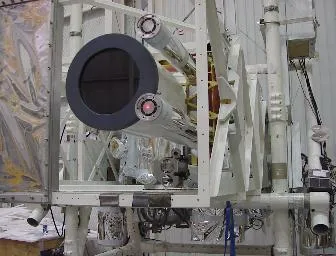
So Ramsey and some colleagues built an extraordinary "tilted" mirror that can capture high-energy X-rays (also called "hard" X-rays). "It's called a grazing incidence mirror," explains Ramsey, who is the principal investigator of HERO, "and it can guide very high-energy X-rays."
Recently, Ramsey's team tested the device nicknamed HERO (acronym for High Energy Replicated Optics) aboard a balloon launched from Fort Sumner, New Mexico. The balloon carried HERO above 99% of Earth's atmosphere where it could capture X-rays from space. The data are being analyzed and the results will soon be available; the team hopes to obtain new cosmic images with a detail never before seen.
The HERO team is one of many scientific groups that ask the experts of the Columbia Scientific Balloon Facility, in Fort Sumner, to launch payloads using these enormous balloons. When fully inflated, the HERO balloon measures 152 meters wide and rises 305 meters above the payload. The balloon team inflates, launches, tracks, and recovers them. Because in May and September wind conditions are favorable (that is, there is little or no wind), Fort Sumner is an excellent site to work with balloons in those months.
"People come out to watch and ask questions," says Ramsey. "A little boy asked me if our huge telescope ever landed on top of a cow." (No!) Ramsey added that the residents of Fort Sumner are friendly and helpful. "They even have barbecues for us from time to time," he added. Ramsey is used to Southern hospitality, since the Marshall Space Flight Center is located in Huntsville, Alabama.
HERO's optics, designed and built in Huntsville, include 96 "grazing incidence" mirrors shaped like tubes, arranged like the layers of an onion.
Why the strange shape? Because high-energy X-rays would pass through the kind of flat mirrors we look into every morning while brushing our teeth. To prevent these high-energy photons from passing through the mirrors, they must be oriented almost completely sideways so that the photons of X-rays bounce off the surface. From there, the photons travel through the tubes to detectors that form an image.
When these tubes finally reach space, they will capture photons from some of the most violent objects in the universe: exploding stars, colliding galaxies, and black holes, just to name a few. The internal violence of these objects is what makes their photons so energetic and is the reason why astronomers need high-energy X-ray telescopes to study them.
The HERO team had to climb a slippery slope to elevate their innovative optics. The first attempts failed —each for a different reason. The weather was the worst of the obstacles.
"We have daily weather briefings," says Ramsey. "When they say 'the weather will not be suitable for conducting a launch until next Wednesday,' you have to consider the possibility of staying another week in the motel room. And there are only two restaurants nearby, which you get tired of going to. Plus, this causes some discouragement."
If bad weather is added to a few technical difficulties that cause the failure of some flight attempts, the result will be frustrated scientists.
So, if using balloons is so difficult and unpredictable, why does this team rely on a balloon to carry out their experiment? Ramsey says the benefits are greater than the difficulties. "A balloon mission costs much less than a satellite mission, about 1 million versus 100 million or more," he explains. "The truly wonderful thing about using balloons is the fact that the payloads can be reused and the turnaround time is short. After parachute landing, the team makes the necessary repairs to the payload and prepares it to fly again in less than a year. Also, due to its short duration, a balloon mission provides a very good training opportunity for those university students doing research for a thesis or dissertation."
And what will happen with the future of HERO? Ramsey hopes to send it to the sunny skies of the southern hemisphere —to Australia, to be exact. The HERO team submitted a proposal for their payload to fly from there within a year.
"Australia is an interesting place for us to do the flights because the galactic center is clearly visible from there. The galactic center is the most active part of our galaxy. Many [hard X-ray] sources are clustered there and with our optics we will be able to break them down into individual sources and capture images that no one has taken until now."
Meanwhile, a large white balloon drifts high in the New Mexico sky and from it hangs a telescope full of mirrors that open the doors to a completely new world. As Alice would say, "There are such beautiful things inside!"
Sources and related links
Note on Science@NASA