A story of sources that emit a huge amount of energy is proposed by Dr. Marc Ribó of the University of Barcelona.
There are topics that are more straightforward, more illustrative when it comes to giving them an image in our brain. We talk about planets and we imagine them, we talk about asteroids and those potato-shaped giant rocks come to mind, about stars, we just have to wait for nightfall, but when the universe offers us another menu, comprehension is more precarious, at least for a great majority of people. Sources of high energies and instruments scattered across the planet to be able to observe them: that is what Dr. Marc Ribó of the University of Barcelona proposes. While you drink a coffee, particles of extremely high energies arrive on Earth every instant. And they bring a lot of information and just as many doubts.
- New ultra-energetic sources, objects that we still don't know well what they are, how and why they behave in a certain way. Marc, before talking about this, tell us where you work
I work at the University of Barcelona as a physicist and I have lived almost my entire life there. In Spain there is no division between physics and astronomy, you have common subjects and then if you want you specialize. I chose the astronomy specialty, my thesis advisor was Josep Maria Paredes who is a collaborator of Gustavo Romero (a researcher at this Faculty and the Instituto Argentino de Radioastronomía). I got my doctorate in 2002 and I spent three years doing a postdoc in Saclay with Félix Mirabel. I went to work on projects we had underway and on new work. In May 2006 I returned to Barcelona.
- What is the topic you chose to research?
Basically, it's about high-energy sources in the Milky Way, the main topic is that: from objects that are known to those that are not. I especially dedicate myself to X-ray binary stars, formed by a more or less normal star and a compact object that can be a neutron star or a black hole. It is thanks to the presence of the compact object, with its intense gravitational field, that the emission of X-rays is produced. In particular, I dedicate myself to X-ray binary stars that emit very high-energy gamma rays, in the teraelectronvolt range.
- You mention teraelectronvolts
Let me explain, in physics we quantify the energy of photons, which are the particles of light. So, a photon with an energy of one electronvolt (1 eV) emits in infrared light, one of 2 eV in visible light, and one of 10 eV in ultraviolet. When we go to higher energies we talk about kiloelectronvolts (keV) in X-rays, Megaelectronvolts (MeV) in gamma rays, Gigaelectronvolts (GeV) in high-energy gamma rays and finally Teraelectronvolts (TeV) in very high-energy gamma rays. A photon with an energy of 1 TeV is a million million times more energetic than a photon of visible light!
- They are X-ray binaries but you talk about gamma rays
X-ray binaries were discovered in the 1960s, and were detected by small rockets that could observe their emission outside the atmosphere. These objects show most of their luminosity in X-rays (keV), while they show little luminosity in gamma rays in the GeV and TeV ranges. On the other hand, I work on X-ray binaries where most of the luminosity is in high-energy gamma rays (GeV), and which show lower luminosity in X-rays and TeV. We are actually starting to call these objects gamma-ray binaries. The emission in high-energy gamma rays was not discovered until satellites with suitable detectors were launched in the late 1970s and early 1990s.
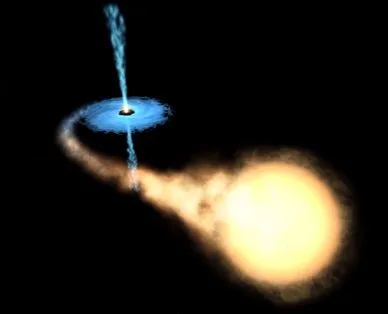
What happens in that pair of stars is that the compact object absorbs material from the other object and forms an accretion disk that falls onto the compact object. Actually we still don't know exactly how these X-ray binaries that emit in very energetic gamma rays work, and there are two possible ways. Let's go step by step: In conventional X-ray binaries the compact object captures material from the other object and often forms an accretion disk of matter, which falls towards the compact object. Perpendicular to this disk, two relativistic jets of particles moving at high speed are ejected. These are the objects we call microquasars, little brothers of quasars, and on which Mirabel and Romero have worked extensively. Well then, gamma-ray binaries could be microquasars, where the interaction between the jets and the wind from the companion star gives rise to the emission in high-energy gamma rays.
The other scenario is totally different. The compact object would in this case be a neutron star, with an intense magnetic field, which would spin very rapidly, on the order of 20 times per second. Actually the object is a pulsar with a period of a few tens of milliseconds. What happens is that by spinning so fast the neutron star releases a great amount of energy: particles come out expelled at high speed and a relativistic wind is produced. This wind is very powerful and, upon colliding with the wind from the companion star, produces high and very high-energy gamma emission.
Thus, we can say that in one scenario the engine would be gravitational energy while in the other it would be rotational energy. Which of these engines is the cause of gamma-ray binaries? We still don't know.
- That companion star doesn't seem very striking, does it?
That's right, it's a massive but more or less normal star.
- Let's continue with the two possible panoramas
In that scenario there would be accretion, relativistic jets and a series of effects that would generate the gamma emission, and in the other scenario there would be that wind that would interact with the companion's wind and a shock would occur through which particles would acquire energy—what is called particle acceleration—and then we would have gamma-ray emission. In particular I am studying the radio emission with a technique called VLBI (Very Long Baseline Interferometry). You study the structures much better than in optical. Basically we are seeing what the morphology of these radio sources is and how it changes over an orbital period to see if it does so more or less according to one model or the other. The instrument I use is the VLBA (Very Long Baseline Array), it is in the USA and is a set of ten antennas installed from the Virgin Islands to Hawaii; it is an array of antennas that observe simultaneously. Then you can reconstruct an image and have it with much more resolution. If the antennas are located thousands of kilometers apart, we talk about very long baseline interferometry.
- Are there many binary stars you are studying?
We know only two systems and a third one that is very clearly a pulsar. In the two binary cases there are several groups of us working using various instruments in different ranges. Those systems are called LS 5039 and LS I + 61 303. In this last one we work together with Gustavo Romero and perhaps he will do it in the other system—I have given him reasons to do it!
- What connects you with the La Plata group?
It is a collaboration that started in the year 2000, with Gustavo and in an article about LS 5039; studying its proper motion, how it moved in the sky and then about some bubbles it had created in neutral hydrogen. Dr. Paula Benaglia also joined. From there Romero began to work with the Barcelona group, with my thesis director, Dr. Josep Maria Paredes. I also work a lot with Dr. Jorge Combi, Argentine and who is currently in Jaén.
Now, in particular I am working with Paula, on a source that we discovered by accident and that has nothing to do with this. Because sometimes one looks for counterparts of the high-energy sources, we see what is in the catalogs at different wavelengths and finds an interesting thing that is not related to a high-energy source but we take it anyway. It would be a star-forming region.
- What can you tell us about all the instrumentation there is for these topics?
In teraelectronvolts there is a project called MAGIC, where I work, and another called HESS. Each one studies one of the two systems and has its own theorists. There are two more, Cangaroo III and VERITAS; they are Cherenkov telescopes that observe the atmosphere and detect the blue light produced in it by gamma rays in a very high energy range.
- Explain a bit more about those gamma rays
The gamma ray reaches the upper atmosphere; upon interacting with it, it produces a cascade of particles; these particles move at a speed greater than light in the atmosphere; flashes of bluish light are produced that we detect with Cherenkov telescopes; these telescopes work in the optical range and have very fast readout cameras to detect the blue flashes. Recently they dismantled one that detected that light in water.
- Does the water contain them?
When there are particles that move in a medium at a speed faster than the speed of light in that medium, this type of Cherenkov light is produced that can be detected with photomultipliers. MILAGRO, which was in the United States, measured that light when the particles produced by the gamma rays entered the pool.
In the air they moved at a very high speed and in the pool they went faster than the speed of light in water. CAUTION: NOT FASTER THAN LIGHT IN A VACUUM.
In January 2008 a new satellite called GLAST will be launched that is going to revolutionize the data, it is for the gigaelectronvolt range.
- It must be quite stimulating to work on something where technology and new instruments provide you with more and more elements
It is certainly stimulating. Four years ago we had, in the teraelectronvolt range, 10 confirmed sources and currently we know 75. We are learning a lot of physics.
- Who contributes more to surpass the available instruments, to make a technological leap? Is it the scientists who push the engineers, technicians, or does this arise independently?
There is a double aspect, we scientists want more, we want to lower the "noise" of the instruments, have more sensitivity, and on the other hand, engineers, in their workplaces, are required to make technological developments. It is a coexistence that for a conventional astrophysicist is very curious. Sometimes we don't want them to change the instruments while we are taking data because it makes data taking and comparison more complicated for us; we prefer it to be done every two or three years but it is true that we always appreciate the innovations when they work well from the first day.
- What did you think of the Astronomers' Meeting recently held in Malargüe?
The talks were very good, the organization was very good and I had the opportunity to be with many people I wanted to meet. On the other hand, it was a unique opportunity to see the Auger cosmic ray observatory, which is a true marvel and we hope it will provide very interesting data in the coming years. Also I saw landscapes that one doesn't have in Spain.
See images at:
http://www.fcaglp.unlp.edu.ar/~extension/225/Ribo/
Sources and related links
Newsletter of the La Plata Astronomical Observatory Year 6 - Number 225 By Alejandra Sofía