The Hubble Space Telescope captured an image of NGC 3603, a giant nebula that hosts one of the most massive young star clusters in the galaxy.
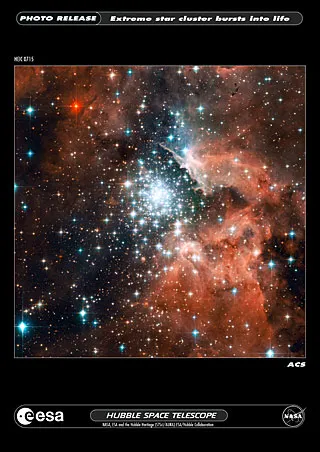
NGC 3603 Credit: NASA, ESA and Hubble Heritage (STScI/AURA)-ESA/Hubble Collaboration
NGC 3603 is a prominent star-forming region located in the Carina spiral arm of the Milky Way, about 20,000 light-years away from our Solar System.
The image shows a young cluster surrounded by a vast region of dust and gas. Most of the bright stars in the image are hot blue stars whose ultraviolet radiation and violent winds have opened a cavity in the gas and dust enveloping the cluster.
The photo shows stars of different masses but similar ages in the cluster. This allows for the detailed analysis of different types of stars that are at different stages in their lives. Astronomers can then compare clusters of different ages and determine which properties (such as temperature and brightness) change as the stars grow older.
According to astronomer Dr. Jesús Maíz Apellániz of the Instituto de Astrofísica de Andalucía, who leads the research, the cluster appears to gather the most massive stars in its core. He and his team have discovered that the distribution of different types of stars in the center of this dense cluster is similar to other younger ones in the galaxy.
The team has also found that three bright stars in the center seem to make us believe they are more massive than theory allows. These heavy stars would actually be two or more massive individual stars whose lights have merged. Even with Hubble's resolution it is not possible to separate the individual stars in each of the three systems. These discoveries agree with a recent one by Dr. Anthony Moffat of the University of Montreal who used ESO's VLT and Hubble's NICMOS infrared camera to measure the movements of individual stars in two of the three systems. The scientist measured the greatest individual mass at about 115 solar masses, which is within the acceptable limits of conventional theory.
NGC 3603 contains around 400,000 solar masses of gas. Hiding in this enormous cloud are some Bok globules (see in the upper right corner of the image), named after Bart Bok discovered them in the 1940s. These are dense clouds of dust and gas with masses between 10 to 50 times greater than our Sun. They resemble insect cocoons and are in gravitational collapse to form new stars. These globules appear to be some of the coldest objects in the Universe.
NGC 3603 was discovered by Sir John Herschel in 1834. It is known to harbor a blue supergiant called Sher 25 that can be seen above and to the left of the densest part of the cluster. The star is thought to be near the critical point to explode as a supernova.