Astronomers have measured the mass distribution within a dark filament in a molecular cloud with an incredible level of detail and at great depth. The measurement is based on a new method that searches for scattered near-infrared light and was performed with ESO's New Technology Telescope. Associated with the upcoming VISTA telescope, this new technique will allow astronomers to better understand the cradles of newborn stars.
The vast expanses between the stars are permeated with gas and dust opaque to light that will be the future nurseries of stars yet to be born.
"One would like to have detailed knowledge of the interiors of these dark clouds to better understand when and where new stars will appear," says Mika Juvela, author of a paper reporting the results.
Since the dust in these clouds blocks visible light, the distribution of matter in interstellar clouds can be examined only indirectly. One method is based on measurements of the light from stars that are located behind the cloud.
When the light from background stars passes through the cloud, it is absorbed and scattered, and as a result the background stars appear redder than they really are. The effect is proportional to the amount of dark material and thus is greater for stars that are situated behind the densest parts of the cloud. By measuring the degree of this 'reddening' experienced by stars seen through different areas of the cloud, it is possible to map the dust distribution in the cloud. The more background stars there are, the more detailed the map and the information about the internal structure of the cloud will be. And that is exactly the problem: even small clouds are so opaque that only a few background stars can be seen through them. Only large telescopes and extremely sensitive instruments are capable of observing a sufficient number of stars to produce significant results.
In 2006, astronomers Paolo Padoan, Juvela and Veli-Matti Pelkonen, proposed that maps of scattered light could be used as another tracer of the internal structure of the cloud, a method that should yield greater advantages. The idea is to estimate the amount of dust located along the line of sight by measuring the intensity of the scattered light.
Dark clouds are faintly illuminated by nearby stars. This light is scattered by the dust contained in the clouds, an effect called 'cloudshine' [1] by Harvard astronomers Alyssa Goodman and Jonathan Foster. This effect is well known to sky lovers as it creates in visible light the wonderful pieces of art called reflection nebulae. The Chameleon Nebula is a beautiful example.
By making observations in the near-infrared, art turns into science. Near-infrared radiation can propagate farther into the cloud than visible light and scattered light maps can be used to measure the mass of material within the cloud.
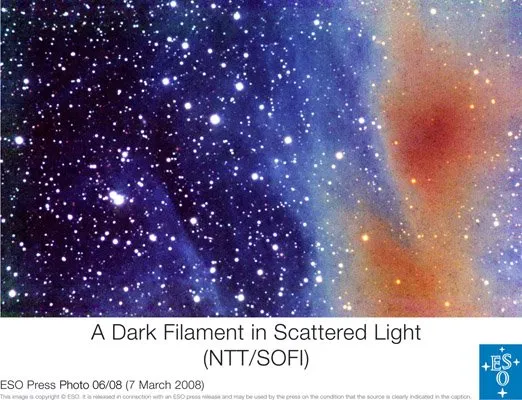
To test the method and use it for the first time for a quantitative estimate of the mass distribution in a cloud, the astronomers who made the original suggestion, together with Kalevi Mattila, performed near-infrared observations of a filament in the Corona Australis cloud.
The cloud is located in the constellation of the same name, Corona Australis (which comes from the Latin Southern Crown). The molecular cloud is cigar-shaped and 45 light-years long. It is located 500 light-years away and contains the equivalent of 7000 Suns. In the sky, the cloud is surrounded by many reflection nebulae.
The observations were made in August 2006 with the SOFI instrument on ESO's New Technology Telescope (NTT) at La Silla, in the Chilean Atacama desert. The filament was observed for about 21 hours.
The observations confirm that the method is yielding reliable results.
"We can now obtain high-resolution images of dark clouds and thus better understand their internal structure and dynamics. Not only does the level of detail of the maps no longer depend on the distribution of background stars, but we also show that where the cloud density becomes too high to be able to see any background star, the new method can still be applied," explained Juvela.
The report appears in this week's edition of Astronomy and Astrophysics.
Sources and related links
- ESO: Seeing through the Dark
- A&A 480, 445-458 (2008)
DOI: 10.1051/0004-6361:20078470
A Corona Australis cloud filament seen in NIR scattered light - I. Comparison with extinction of background stars
M. Juvela, V.-M. Pelkonen, P. Padoan, and K. Mattila - [1]
CfA: Cosmic Cloudshine: Its Beauty Is More Than Skin Deep
About the images
ESO PR Photo 06/08
Part of a filament in the Corona Australis molecular cloud. Image composite made with the SOFI instrument on ESO's NTT telescope (European Organisation for Astronomical Research in the Southern Hemisphere)