A black hole of 15.7 stellar masses has been detected in a rare binary system it shares with a massive star 70 times larger than the Sun.
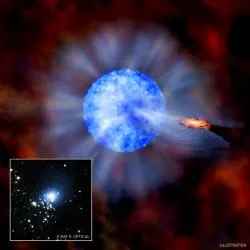
NASA/CXC/M.Weiss; X-ray: NASA/CXC/CfA/P.Plucinsky et al.; Optical: NASA/STScI/SDSU/J.Orosz et al.
The main component of the image is an artistic representation of M33 X-7, a binary system in the nearby galaxy M33. In this system, a star about 70 times more massive than the Sun is orbiting a black hole. The hole is nearly 16 times the solar mass, a record for black holes created from the collapse of a giant star. Other black holes in galactic centers are much more massive, but this object is a record for so-called stellar-mass black holes.
In the illustration, an orange disk surrounds the black hole. The material is fed by the winds from the blue star orbiting the compact object. The wind is pushed toward the black hole by its powerful gravity, which also affects the star, distorting it in the direction of the hole, making it less dense in that region.
The inset at the bottom shows a composite of data from the Chandra X-ray Observatory (in blue) and the Hubble Space Telescope. The bright objects in the inset are young and massive stars around M33 X-7, and the bright blue source is M33 X-7 itself. X-rays from Chandra reveal how much the black hole has been eclipsed by its stellar companion, indicating the size of the star.
M33 is a galaxy about 3 million light-years from Earth. By combining data from Chandra and the Gemini telescope in Hawaii, the mass of the black hole was determined to be 15.7 times the mass of the Sun.
"This discovery raises questions about how such large black holes can form," says Jerome Orosz of San Diego State University, lead author of the paper appearing in the October 18 issue of Nature.
The properties of the system—a massive black hole in a close orbit with a massive companion—are difficult to explain using conventional models of massive star evolution. The original star of the black hole must have been of a much greater mass than the companion.
Such a massive star should have had a radius greater than the current separation between the stars, so the stars would have approached each other by sharing a common outer atmosphere. The typical process results in a large amount of gas being lost from the system, so much so that the original star could not have formed a black hole of 15.7 solar masses.
Co-author Wolfgang Pietsch was also the author of an article in Astrophysical Journal, which used observations from Chandra to report that M33 X-7 is the first black hole in a binary system to undergo an eclipse.
Types of black holes
According to their origin, at least three classes of black holes could theoretically exist:
* Primordial black holes, created early in the history of the Universe. Their masses can be varied and none have been observed.
* Supermassive black holes, with masses of several million solar masses. They are the heart of many galaxies. They form in the same process that gives rise to the spherical components of galaxies.
* Solar-mass black holes. They form when a star with a mass 2.5 times greater than the mass of the Sun becomes a supernova and implodes. Its core concentrates into a very small volume that keeps shrinking more and more.
Sources and related links
- Note on Chandra
- Note on EurekAlert
- Note on UniverseToday