The Hubble Space Telescope has found old stars in a dwarf galaxy that astronomers considered one of the youngest in the Universe.
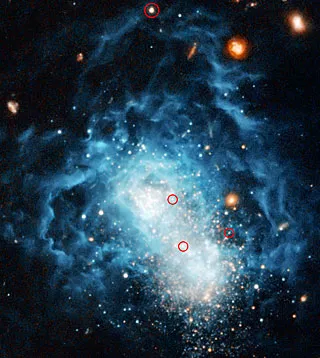
Observations of the galaxy I Zwicky 18 indicate that it is actually older and more distant than previously thought.
Forty years ago, when observing the galaxy from the Palomar Observatory, it seemed to be one of the youngest galaxies in the nearby Universe. Studies suggested it had begun star formation billions of years later than its neighbors, like our Milky Way.
But now, Hubble found faint, old red stars contained in the galaxy, suggesting that star formation began at least one billion years ago and perhaps as much as 10 billion years.
The galaxy, therefore, would have formed at the same time as most.
"Although the galaxy is not as young as we thought, it is certainly of a challenging and unique development in the nearby Universe," says astronomer Alessandra Aloisi of ESA and the Space Telescope Science Institute, who led the new study.
Spectroscopic observations from ground-based telescopes have shown that I Zwicky 18 is composed mainly of hydrogen and helium, the main ingredients created in the Big Bang. In other words, the stars it contains have not created the same amount of heavy elements seen in other neighboring galaxies. This suggests a lower star formation rate than galaxies of the same age.
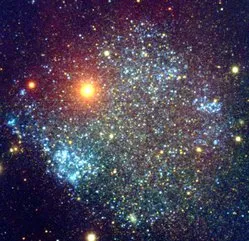
I Zwicky 18 was studied with several telescopes, including Spitzer, Chandra, and FUSE.
It remains a mystery why the galaxy has such a low formation rate, both in the past and currently.
From Hubble's data, it is deduced that the galaxy is 59 million light-years from Earth, almost 10 million light-years farther than believed. By galactic standards this is still our backyard, but it explains the difficulty in detecting the oldest and faintest stars.
Aloisi and her team distinguished the new distance by observing Cepheid variables. These massive stars pulsate with a regular rhythm. The rhythm of their pulsations is directly related to their brightness. By comparing their actual brightness with the observed brightness, astronomers can precisely measure their distance. The team determined the observed brightness of three Cepheids (marked with red circles in the image) and compared them with their actual brightness predicted by theoretical models to determine their distance.
The Cepheid distance was also validated through another indicator, specifically the observed brightness of the brightest red stars, the red giants.
Cepheid variables have been studied for decades and have been used in determining the scale of the Universe. This is the first time, however, that variables with so few heavy elements have been found.