A team of astronomers discovered a cosmic explosion that appears to come from the middle of nowhere - thousands of light-years from the nearest collection of stars, gas and dust. This "shot in the dark" is surprising because the type of explosion, a long-duration gamma-ray burst (GRB), is thought to be generated by the death of a massive star.
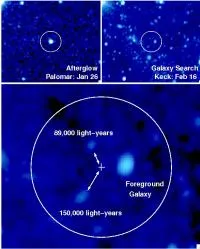
"Here we have a brilliant burst, yet it is surrounded by darkness on all sides," says Brad Cenko of the California Institute of Technology, author of his team's paper, which has been accepted for publication in The Astrophysical Journal. "The nearest galaxy is more than 88,000 light-years away, and there is almost no gas between the burst and Earth."
The burst was detected on January 25, 2007 by several spacecraft of the Inter-Planetary Network. Observations by the Swift satellite located the explosion, called GRB 070125, in a region of the sky in the constellation Gemini. It was one of the brightest bursts of the year and the Caltech/Penn State team moved quickly to observe the burst site with ground-based telescopes.
Using the 60-inch telescope at Palomar Observatory in California, the astronomers discovered that the burst had a bright and fast afterglow in visible light. This prompted the need to observe the afterglow in detail with two of the largest telescopes, the 8 m Gemini North and the 10 m Keck I, both near the summit of Mauna Kea in Hawaii.
What came next was a total surprise. Contrary to experience with more than a hundred previous GRBs, the Gemini spectrum revealed no signs of dense gas and dust absorbing the light from the afterglow. A trace of magnesium revealed that the burst took place more than 9.4 billion years ago, as deduced from the shift in the wavelength of the light, and that the surrounding gas and dust was more tenuous than the environment near any previous burst.
The group also obtained images from Keck after the afterglow had faded. Surprisingly, the images showed no galaxy at that location.
Astronomers have accumulated much evidence that GRBs are triggered by the explosions of massive stars that have a short life. Since their lifetime is short, these stars have no time to wander far from their birthplace, usually dense clouds of gas and dust within galaxies. So GRB 070125 makes astronomers ask how it is possible that a massive star could be found far from any galaxy.
One possibility is that the star formed in the outskirts of an interacting galaxy as seen in the famous Hubble image of the "Tadpole" galaxy, UGC 10214. "In the local Universe, about one percent of star formation occurs in gravitational tails, in the outskirts of two interacting galaxies, so it would make sense to find 1 in 100 gamma-ray bursts in such an environment," says Cenko.
If this idea is correct, it should be possible to detect the gravitational tail that hosted the burst with a long exposure from Hubble, which will be the team's next step.
"Many Swift discoveries have left astronomers scratching their heads, but this discovery of a long GRB without a host galaxy is one of the most astonishing of all."
Sources and related links
- Note on EurekAlert
- 'Shot in the Dark' Star Explosion Stuns Astronomers
About the images
The Palomar telescope took the image of the afterglow of GRB 070125 on January 26, 2007. On the right, an image of the same field on February 16 with the Keck I telescope, with no trace of the afterglow or a galaxy. The lower image is a close-up in which the location of the afterglow is marked with a white cross and the nearest galaxies are indicated with arrows, at 89,000 and 150,000 light-years away.
The elliptical blob (Foreground Galaxy) is a background galaxy.
Image credit: B. Cenko, et al.