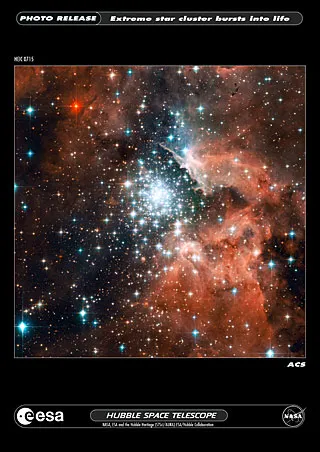
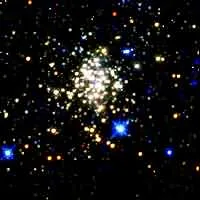
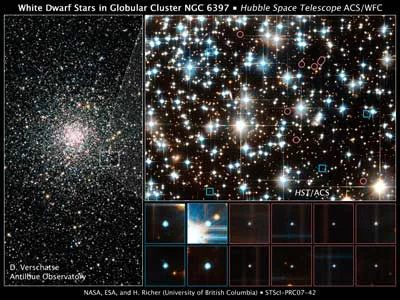
Stars evolve in large groups known as clusters. Astronomers distinguish these formations by their age and size. The question of how clusters are created from interstellar gas clouds and why they later develop into different shapes has now been answered by researchers from the Argelander Institute for Astronomy at the University of Bonn, with the help of computer simulations.
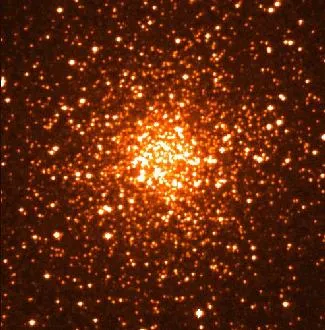
Globular cluster 47 Tucanae (NGC 104)
Scientists have solved, at least on a theoretical level, one of the oldest astronomical puzzles about whether star clusters differ in their internal structure. The findings have been published in the scientific journal "Monthly Notices of the Royal Astronomical Society" (MNRAS 380, 1589).
Astronomical observations have shown that all stars form in star clusters. On one hand, small ones with young stars are distinguished, containing between hundreds and several thousand stars; on the other hand, the large and dense globular clusters consisting of millions of stars as old as the Universe. No one knows how many clusters there should be of each class because scientists had not computed the physical processes behind their genesis.
Stars and clusters form from the collapse of interstellar gas clouds. In these clouds, individual groups emerge and under their own gravitational pull come closer and closer together until they become stars. Like our solar wind, stars expel strong streams of charged particles. These "winds" literally sweep away the remaining gas from the cloud. What remains is a cluster that gradually disintegrates until its component stars can move freely in the interstellar space of the Milky Way.
Scientists believe our own Sun was born in a small star cluster that broke apart over the course of its development. "Otherwise our solar system would probably have been torn apart by a star moving nearby," says Professor Dr. Pavel Kroupa of the University of Bonn. To better understand the birth and death of stellar aggregations, Kroupa and Dr. Holger Baumgardt developed a program that simulates the influence of the remaining gases in a cluster on the path taken by the stars.
Heavy clusters live longer
The main topic of the research has been about what the initial conditions should be like for a new star cluster to survive for a long time. Astronomers discovered that clusters below a certain size are very easy to destroy by the radiation from their component stars. Heavier star clusters, on the other hand, enjoy better chances of survival.
For astronomers, another important conclusion is that both types (the lighter and the heavier) have the same origin. As Kroupa explains, "It seems that when the Universe was born there were not only globular clusters but also countless small star clusters. A challenge now for astrophysicists is to find their remains."
The Argelander Institute has recently been equipped with five GRAPE computers, which operate at speeds 1000 times higher than normal PCs.
Sources and related links
- Note on EurekAlert
- Note on ScientificBlogging
- Note on University of Bonn