A high-resolution image (50 times sharper than Hubble) of the radio galaxy M87 in which the energy jets it emits can be appreciated.
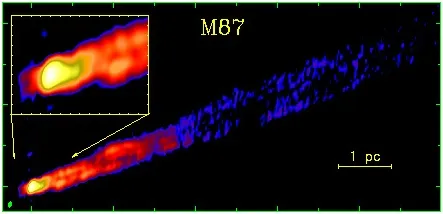
M87 by Y.Y. Kovalev, MPIfR Bonn
M87, the central galaxy of the Virgo Cluster at 50 million light-years, was observed by Yuri Kovalev of the Max Planck Institute for Radio Astronomy (MPIfR) in Bonn and his colleagues from the VLBA (Very Long Baseline Array) at a wavelength of 2 cm. The resulting image is of very high resolution.
The image was taken in the radio part of the spectrum using the interferometry technique, where the ability of separate telescopes is combined, in this case with the VLBA.The image shows a bright jet and a diffuse counter-jet. The detection of the counter-jet is important. It is assumed that the jets coming out of radio galaxies are double. But in this case, usually only one is seen, supposedly because it is pointing towards us, and due to relativistic effects, the second one is not seen.
M87 is a very massive galaxy and the central object of the Virgo Cluster at 16 Megaparsecs (about 50 million light-years).
"The first jet structure, emanating from the nucleus of a galaxy, was found in M87," says author Ken Kellermann of NRAO. The galaxy was among the first to be recognized as having a powerful source of radio emission.
The energy of those powerful radio galaxies seems to be a central engine, the AGN or Active Galactic Nuclei. AGN are thought to consist of supermassive black holes at the center of the galaxy. In the case of M87 it would be 3 billion solar masses. A rapidly rotating gas disk around the nucleus (accretion disk) feeds the black hole and matter is ejected from the nucleus in jets orthogonal to the disk.
From a theoretical point of view, the Russian astrophysicist Iosif Shklovsky argued as early as 1964 that those jets in powerful radio galaxies, feeding the double radio lobes in objects like Cygnus A or Virgo A, were possibly two-sided. The observation of one side in most jets, the scientist suggested, could be due to relativistic Doppler emission, increasing the luminosity of the jet in the direction of the observer.
"With our new observations, we can confirm the structure of a weak counter-jet in M87 and thus provide evidence for Shklovsky's theoretical assumption," says Kovalev.
Sources and related links
- Note on Physorg
- Note on BadAstronomy
- Press release at MPIfR