A small galaxy -halfway across the Universe- the smallest in size and mass known at that distance, has been identified by an international team of scientists.
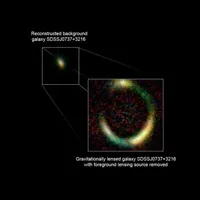
NASA, ESA, and P. Marshall and T. Treu (University of California, Santa Barbara)
The data were collected using the Hubble Space Telescope and the W.M. Keck in Hawaii. The galaxy is approximately half the size and one-tenth the weight of the distant galaxies typically observed and about 100 times less massive than our Milky Way.
The discoveries will be published in the December 20 edition of Astrophysical Journal. The article is already available online at http://arxiv.org/abs/0710.0637 .
"Although the galaxy is more than 6 billion light-years away, the image is as sharp as those obtained of nearby structures, such as the Virgo Cluster which is 100 times closer to us," explains author Phil Marshall of the University of Santa Barbara.
The second author, Tommaso Treu, explains that this is possible because the new galaxy is behind another massive galaxy, creating an "Einstein ring." This is the name for the effect by which the light from a background galaxy is magnified by a massive galaxy closer to us. The gravity of the massive galaxy causes the light from the more distant one to bend. The effect is called gravitational lensing.
Treu and his colleagues in the SLACS (Sloan Lens ACS Survey) study are at the forefront of this type of research. With gravitational lenses, the light from distant galaxies is deflected on its way to Earth by the gravitational field of some massive object in its path. As the light bends, the galaxy appears distorted into an arc or separate images. When both galaxies are aligned, the light forms a circular pattern known as an Einstein ring, around the foreground galaxy.
To estimate the galaxy's mass, optical and near-infrared images from Hubble were combined with images at longer wavelengths obtained with Keck. "If the galaxy is representative of a larger population, it could be one of the building blocks of today's spiral galaxies or, perhaps, a progenitor of modern dwarf galaxies," says Treu. "It looks remarkably similar to the smallest galaxies in the Virgo Cluster, but it is almost halfway across the Universe."
Another key in the research is the use of the adaptive optics technique. This system uses bright stars in the field of view to measure the blurring caused by the atmosphere and correct it in real time. The technique requires having a bright source, usually a star. But the laser guide star at Keck illuminates the layer of sodium atoms that exists in the atmosphere, acting as an artificial star, with enough brightness to perform the correction anywhere in the sky, regardless of whether there is a bright star or not.
Sources and related links
- Note at Keck
- Note at Physorg
- Note at HubbleSite