A new study discovered that the youngest white dwarfs in a globular cluster were not where they were expected, near the core, but on the outskirts of the cluster, leading to speculation that they received some kind of impulse that carried them to their current location.
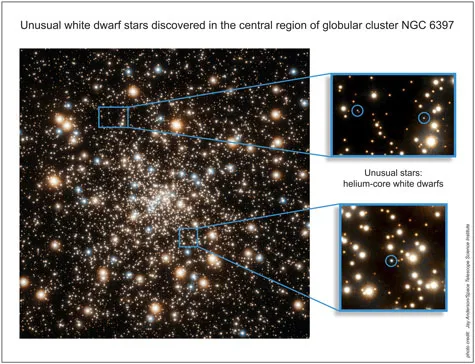
Through Hubble, the speedy white dwarfs were discovered in the old globular cluster NGC 6397.
Before the stars ended up as white dwarfs, they were among the most massive in the cluster. Since massive stars are thought to gather in the core of the globular cluster, astronomers assumed that most of the white dwarfs formed would also reside near the center.
However, the newly discovered white dwarfs reside at the edge of the cluster.
"The distribution of the young white dwarfs is exactly the opposite of what we expected," says astronomer Harvey Richer of the University of British Columbia in Vancouver. "Our idea is that as stars evolve into white dwarfs they receive an impulse of between 3 and 5 kilometers per second that sends them to the outskirts of the cluster."
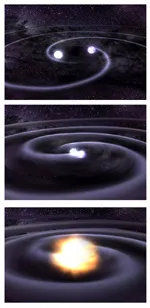
Richer suggested that these stars propel themselves by ejecting mass, like rockets. Before reaching this state, the stars swell into red giants that lose half their mass by expelling it into space. If more of this mass is ejected in one direction, it could propel the nascent white dwarf into space.
Observations of some planetary nebulae (the bright material ejected by red giants) show similarities. The jets in those planetary nebulae flow in opposite directions. If they are not perfectly balanced, Richer reasoned, the stronger jet could accelerate the white dwarf in the opposite direction.
The idea that white dwarfs are born with such an impulse was suggested 30 years ago to explain why there are so few in open star clusters. In 2003, Michael Fellhauer of the University of California at Santa Cruz and colleagues calculated that if white dwarfs received an impulse, they could be ejected from open clusters. However, it is easier for these stars to escape the weak gravitational pull of open clusters than from globular clusters, which are 100 times more massive.
Richer and his team, however, decided to test the acceleration theory in globular clusters. They chose NGC 6397 because, at 8,500 light-years away, it is one of the globular clusters closest to Earth. About 150 globular clusters exist in the Milky Way, each containing up to a million stars.
The team studied 22 young white dwarfs less than 800 million years old and 62 older white dwarfs, between 1.4 and 3.5 billion years old. Astronomers distinguish the young from the old based on their color and brightness. The young ones are hot and therefore bluer and brighter than the older ones.
In globular clusters, the heaviest stars sink to the cluster's core while the lighter ones gain speed and move through the cluster to its outskirts. The team found that the older white dwarfs behaved as expected: they were distributed throughout the cluster according to their weight.
The younger white dwarfs, however, were unexpectedly found at the edge of the cluster, puzzling the team.
The expected neighborhood was near the center because their progenitor stars were the heaviest in the cluster. These white dwarfs are so young that they have not had enough encounters with other stars to scatter them throughout the cluster, suggesting some other mechanism.
The team considered other explanations for the location of these white dwarfs. They could be part of binary systems and have received an impulse from their companions. Or perhaps they received a push upon encountering heavier stars. However, through simulations, they ruled out those hypotheses.
Richer hopes to study other open clusters in search of "runaway" white dwarfs. The results will appear in the January 2008 issue of
Monthly Notices of Royal Astronomical Society Letters.
Sources and related links
About the images
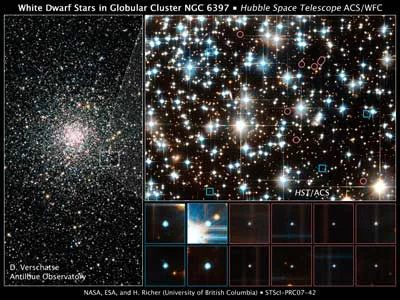
The image on the left, taken by ground-based telescopes, shows the dense swarm of hundreds of thousands of stars that make up the globular cluster. The inset highlights the location of the observations made with Hubble.
The image on the right, taken by the Space Telescope, reveals 12 of the 84 white dwarfs in the study. The blue squares correspond to the young white dwarfs and the red circles to the old ones.
At the bottom, close-up views of the young (blue) and old (red) white dwarfs are seen.
The ground-based telescope images were taken on June 5, 2005. The Hubble images were taken in March and April 2005.
Credit for the ground-based images: D. Verschatse (Antilhue Observatory, Chile)
Credit for the Hubble images: NASA, ESA, and H. Richer (University of British Columbia)