ESO's VLT pushes the search for young galaxies to new limits.
Spending the equivalent of each night for two weeks on the same part of the sky with ESO's VLT Telescope, an international team of astronomers found the faint light of young galaxies billions of light-years away. These galaxies, which the researchers believe are the building blocks of galaxies like our Milky Way, have eluded detection for three decades, despite intense searches.
The team, led by Martin Haenhnelt of the University of Cambridge, Michael Rauch and George Becker of the Carnegie Observatories and Andy Bunker of the Anglo-Australian Observatory, reported their results in a paper to be published in the March 1, 2008 issue of Astrophysical Journal.
"We were trying to measure a faint signal from the intergalactic gas caused by the ultraviolet background radiation. But as often happens in science, we were surprised and found something we weren't looking for: dozens of faint, discrete objects emitting radiation from neutral hydrogen in the so-called Lyman alpha line, a fundamental signature of protogalaxies," explains Rauch.
The same portion of the sky, centered on a quasar, was observed between 2004 and 2006 for 92 hours, the equivalent of 12 full nights, allowing astronomers to obtain a spectrum of the Universe when it was only 2 billion years old.
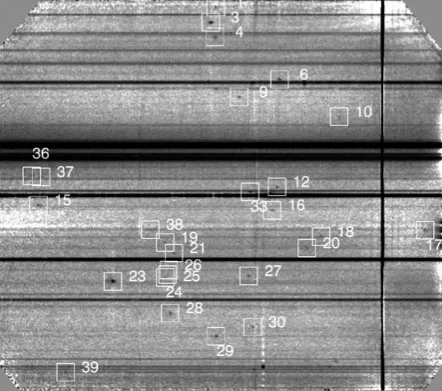
The result of that search is the detection of 27 faint objects. The faint light signal the team detected from these distant objects implies a low star formation rate and a small amount of chemical enrichment, suggesting they are at an early stage of formation.
"The properties of the emissions seem to provide an excellent match with those Damped Lyman Alpha (DLA) systems, the main reservoir of neutral hydrogen in the distant Universe. The new observations confirm theoretical investigations that propose that galaxies like ours formed by the amalgamation of small protogalaxies in the early Universe," adds the scientist.
"What makes our discovery exciting is that it opens the path to finding a large number of building blocks of galaxies and that we are now able to study in detail how galaxies like our Milky Way form," says Haehnelt.
The paper reporting the research is titled: "A Population of Faint Extended Line Emitters and the Host Galaxies of Optically Thick QSO Absorption Systems" by M. Rauch et al.
Sources and related links
- Press release at ESO
- Lyman series
About the image: ESO PR Photo 52/07
The spectrum obtained after 92 hours of exposure time, showing the emission lines of the candidates and the absorption lines of the quasar near the center of the image.