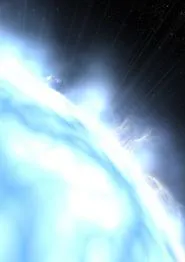
The Chandra X-ray Observatory discovered a supernova remnant with a neutron star moving at an incredible speed.
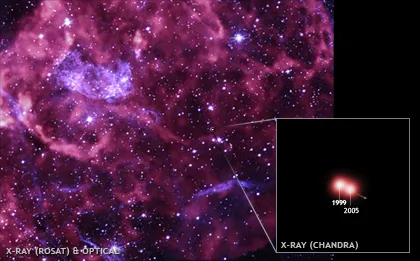
The graphic shows a supernova remnant, Puppis A, along with a close-up of the neutron star known as RX J0822-4300.
It is a composite image made from data from the ROSAT satellite (in pink) and optical data (purple), from the 0.9m Telescope at Cerro Tololo Observatory.
Astronomers think that Puppis A was created when a massive star ended its life in a supernova explosion 3,700 years ago, forming an incredibly dense object called a neutron star and releasing debris into space.
The neutron star was ejected by the explosion. The inset shows two observations of the neutron star obtained by the Chandra X-ray Observatory in December 1999 and April 2005. By combining how far it moved across the sky with its distance from Earth, astronomers determined that it is moving at 3 million miles per hour, one of the fastest stars ever observed. At that rate, RX J0822-4300 is destined to escape the Milky Way, although that would take it millions of years. In fact, it has only traveled 20 light-years so far.
The results of this study suggest that the supernova threw the star to one side and the debris to the other. The estimated location of the explosion is shown in this second image.
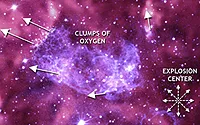
The direction of motion of this true "cannonball," shown with an arrow, is opposite the direction of motion of the oxygen-rich remnants, seen at top left. In each case, the arrows show the estimated motion over the next 1,000 years.
Sources and related links
- Note on Chandra
- Paper: Direct Measurement of Neutron Star Recoil in the Oxygen-rich Supernova Remnant Puppis A
Image credit: NASA/CXC/Middlebury College/F.Winkler et al; ROSAT: NASA/GSFC/S.Snowden et al.; Optical: NOAO/AURA/NSF/Middlebury College/F.Winkler et al.