M51, whose name comes from being entry number 51 in Charles Messier's catalog, is considered one of the classic examples of a spiral galaxy.
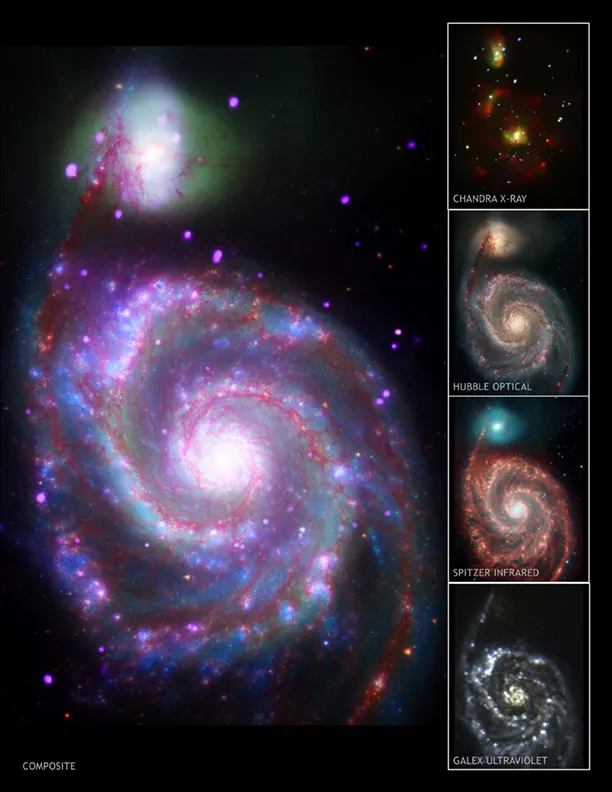
At a distance of 30 million light-years from Earth, it is also one of the brightest spirals in the sky. An image composite of M51, also known as the Whirlpool Galaxy, shows the majestic structure thanks to several observatories. X-ray data from the Chandra Observatory reveal sources (in purple) that are black holes and neutron stars in binary systems. Chandra also detected a diffuse glow of hot gas that permeates the space between the stars. Optical data from the Hubble Space Telescope (green) and infrared emissions from the Spitzer Space Telescope (red) highlight long lanes in the spiral arms consisting of stars and gas intertwined with dust. A view of M51 with the GALEX telescope shows young, hot stars that produce a lot of ultraviolet energy (blue).
The structure is thought to be the result of an interaction between M51 and its closest neighbor, NGC 5195, seen just above. Some simulations suggest the spiral shape was partly caused when its companion passed through its disk 500 million years ago. This gravitational interaction may have triggered the star formation rate in M51.
Sources and related links
About the images
Credit: X-ray (NASA/CXC/Wesleyan Univ./R.Kilgard); UV (NASA/JPLCaltech); optical (NASA/eSA/S. Beckwith & Hubble Heritage Team (STScI/AURA)); IR (NASA/JPLCaltech/ Univ. of AZ/R. Kennicutt)