Using a computer simulation model, Haruichi Washimi, a physicist at the University of Riverside, predicted that the Voyager 2 spacecraft will cross the region called the "termination shock".
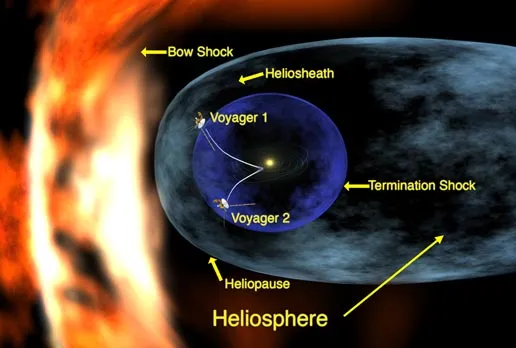
The termination shock region is where the solar wind, a small stream of charged particles continuously flowing out from the Sun, slows down due to gas from the stars. In this region, the solar wind abruptly decreases and becomes denser and hotter.
According to the simulations, the spacecraft would cross the zone at the end of 2007, beginning of 2008. To make this forecast, the scientist and his colleagues used data from Voyager 2 and performed a "magneto-hydrodynamic" simulation, a method that allows precise and quantitative predictions of geomagnetic disturbances caused by solar activities.
The results of the study will appear in the December 1st edition of The Astrophysical Journal.
"It is truly remarkable given the enormous complexity of the physics involved, as well as the time and space scales and the variability of the solar wind conditions," adds Gary Zank, director of the Institute of Geophysics and Planetary Physics and coauthor of the paper.
The solar wind -a stream of charged particles ejected by the Sun in all directions- travels at supersonic speeds when it leaves the Sun, until it finally encounters the interstellar medium made of plasma, gas and dust.
At the termination shock, located between 7 and 8.5 billion miles (between 12 and 13.5 billion kilometers) from the Sun, the solar wind slows down and becomes subsonic. The boundary of this region is not fixed, but fluctuates according to solar activity.
Voyager 2 was launched on August 20, 1977. It visited four planets and their moons in the course of its journey through space. Its twin spacecraft, Voyager 1, launched on September 5 of the same year, crossed the termination shock in December 2004. Both spacecraft are currently operational but the power sources have degraded and part of the instrumentation is not working optimally. In the future, the spacecraft will encounter another milestone: the heliopause.
Sources and related links
- Note on EurekAlert
- NASA Voyager site
- Note at UC Riverside
Image credit: NASA/Walt Feimer