Argentine researchers together with scientists from the United States scrutinized in an unusual way the remains of a star in work that took almost three years and earned the cover of the renowned journal “Astronomy & Astrophysics”.
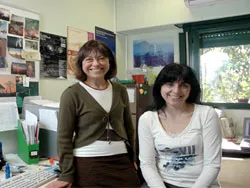
Dubner and Castelletti, at the IAFE. Photo:Cepro/Exactas
Two researchers from the Instituto de Astronomía y Física del Espacio (IAFE) together with scientists from the United States carried out work that earned the cover of the prestigious European journal “Astronomy & Astrophysics”. The study focused on the remains of a supernova named W-44, which, as a worthy star, died spectacularly twenty thousand years ago: an extremely violent explosion ended its life and threw a gigantic injection of matter into interstellar space in less than a second. “This is one of the highest-energy processes that occur in the Universe and happen in an infinitesimal period of time,” highlights Dr. Gabriela Castelletti who closely followed this stellar corpse in her thesis directed by Dr. Gloria Dubner, both authors of the notable “paper” together with Crystal Brogan and Namir Kassim from the National Radio Astronomy Observatory and the Naval Research Laboratory, respectively.
This remnant, the last testimony of what was once a star with a mass greater than twenty suns and that could fuse iron in its interior, still shines in our galaxy. Its emissions were detected by the Very Large Array (VLA) interferometer, a complex of 27 antennas located in the southern United States. “What is striking about this study is the technique used for the discovery,” highlights Dubner, principal researcher at Conicet. “The observation was made in a very little-studied range of the spectrum due to the technical difficulties it presents. It requires an enormous database that is tedious to handle and takes months of processing,” indicates Castelletti. In exchange for these setbacks, the results offer unprecedented details.
If processing tons of data is cumbersome, getting to them is not easy either. First you have to get an observation slot at the VLA center. Scientists from all over the world aspire to the same thing and submit proposals to be evaluated by a jury that will finally rule who can access the sky. “This step was an achievement in itself because our project required mounting a special device on one of the antennas and it is complicated to get it accepted,” relates Castelletti. But in addition to this extra demand, the request asked for details of W-44 taken from different angles. “The 27 VLA antennas can adopt four different positions. But they don't happily switch from one configuration to another; instead, it requires moving them on rails and takes months until the schedule of requests from the researchers who won their slot is completed,” she indicates.
That infernal amount of data captured by the VLA over almost two years was processed on a set of computers, the ‘cluster’ HOPE, at the IAFE in the Ciudad Universitaria in Buenos Aires. “The interferometer provides a grid of points of higher and lower quality that must be worked with mathematical calculations. After months of deciphering the data I was able to obtain the image of W-44,” she specifies. The shout of joy when she managed to assemble that puzzle was heard throughout the institute.
Almost two years of work to have before her eyes on the monitor the remains of that supernova the approximate size of a full moon. “It is really very particular. It is composed of many filaments, a product of its interaction with the interstellar medium. Furthermore, it is located very close to a source of gamma-ray emission, the most energetic in the Universe. And as if that weren't enough, inside W44 resides a pulsar, that is, a compact object formed after the supernova explosion,” emphasizes Castelletti.
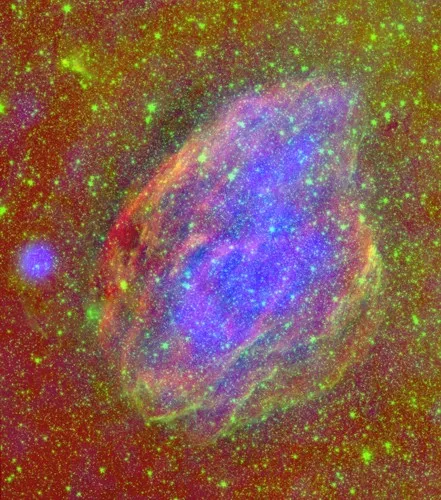
The supernova remnant W-44. Image credit:NRAO/AUI.
If one could touch part of W-44, for example, the pulsar, one would find that “it is a compound of such density that if you gather that material in a coffee spoon, it would weigh as much as all of humanity. The pulsar rotates on itself at high speed and throws jets of energy in opposite directions like a lighthouse in space. As time passes, the spin slows down and thus its age is determined. From the current speed it is calculated that it exploded 20 thousand years ago, and it is located about 10 thousand light-years from Earth, meaning the light signal we receive here today left 10 thousand years ago,” explains Dubner.
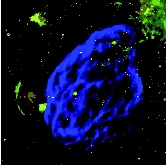
The cover illustration of Astronomy and Astrophysics Vol. 471 No. 2 (August IV 2007)
W44: in blue, green and red for different wavelengths (radio, infrared at 8 and 24 µm).
With the assembled image of W-44, now came the work they wanted to do in celestial physics: study particle acceleration. Part of those results were published in Astronomy & Astrophysics. “Science has not yet answered the origin of cosmic rays and this study may begin to provide it. To understand where those particles that arrive with tremendous energy to Earth are accelerated is why the remains of supernovae are analyzed, because it is assumed they came from there,” points out Dubner. These works also aim at knowledge itself. “What is observed on Earth comes from elements that were once ejected by a supernova. By knowing this, we can understand something more about the Cosmos and our origins. It is, of course, about understanding a very, very, very small part,” concludes Castelletti.
VLA in detail
The VLA observation center is located in New Mexico far from civilization because cell phone or microwave oven activity can affect it. “It consists of 27 antennas that combined simulate a large antenna with a 30-kilometer dish. They move synchronously like a ballet and point to the corner of the Universe that one wishes to explore,” says Castelletti. The observation is free, the requirement to fulfill is a quality scientific proposal that justifies placing the VLA in the requested position.
The paper
The low-frequency radio emission and spectrum of the extended SNR W44: new VLA observations at 74 and 324 MHz
G. Castelletti, G. Dubner, C. Brogan, and N. E. Kassim
A&A 471 2 (2007) 537-549
Doi : 10.1051/0004-6361:20077062
Sources and related links
- Note in UBA Exactas
- Note in La Nación by Cecilia Draghi