It is the first discovery made by the CHASE project. Astronomers confirmed the stellar explosion with the help of software that compares photos.
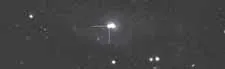
The Swope telescope at Las Campanas took this image after the photos from Saturday. The supernova is to the left of the host galaxy. Photo: Sergio González
A group of astronomers from the University of Chile discovered a supernova on Saturday from an image taken by one of the new robotic Prompt telescopes at Cerro Tololo.
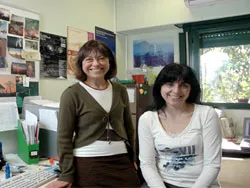
Researchers Giuliano Pignata, José Maza, Mario Hamuy, Roberto Antezana and Luis González detected the stellar explosion, named supernova 2007oc thanks to its enormous luminosity. According to the astronomers, the large collapsed star is 3 billion times brighter than the Sun.
The phenomenon took place in the galaxy NGC 7418A, 75 million light-years from Earth. The luminosity of the supernova is comparable to that of all the stars in the host galaxy.
The software that reviews the images from the Prompt telescopes, from Cerro Calán in Santiago, compared Saturday's image with a previous one of the same galaxy, taken on May 26.
The automatic supernova search program (called Chase: CHilean Automatic Supernova Search) began in March 2007. This is the first discovery made with this methodology.
The hunt follows the procedure of regularly observing a sample of galaxies from the southern hemisphere (typically every 4 days) with the robotic telescopes.
As soon as one of them obtains an image of a galaxy, it immediately transmits it to the computers in Santiago, where the software compares the new image with a previous one.
The 7 differences
The software aligns the images like in the game of the seven differences. When a supernova has exploded, it is detected in the subtracted image as a new bright point.
The Chase project has selected a list of 10,000 galaxies for monitoring.
According to Hamuy, a galaxy typically produces two supernovae per century, so it is necessary to patrol many galaxies to find a new one.
Immediately after the discovery, the researchers analyzed the light from the supernova using the 3.6-meter telescope at the ESO's (European Southern Observatory) La Silla Observatory.
University of Chile Astronomy student Felipe Olivares identified hydrogen gas expelled at 8,000 kilometers per second. This confirmed that it is the explosion of a high-mass star.
The final objective of this project is to measure the origin of the mysterious acceleration of the universe from the distances calculated with supernovae.
This project has the support of the Iniciativa Científica Milenio and Fondecyt.
End of a star
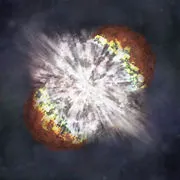
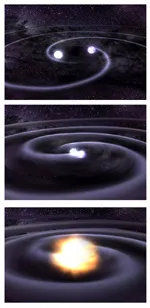
Supernovae occur when massive stars exhaust their fuel and collapse under their own gravity. By suddenly contracting they generate a strong emission of energy, a powerful explosion that in the celestial sphere becomes an object of great brightness that can last from several weeks to months.
OWNER
The PROMPT (Panchromatic Robotic Optical Monitoring and Polarimetric Telescopes) belong to the University of North Carolina.
Sources and related links
- Note in El Mercurio
- Astronomy at the University of Chile