Interview with Dr. Estela Reynoso, Argentine astrophysicist from Rosario, about her latest work on supernova remnant 1006.
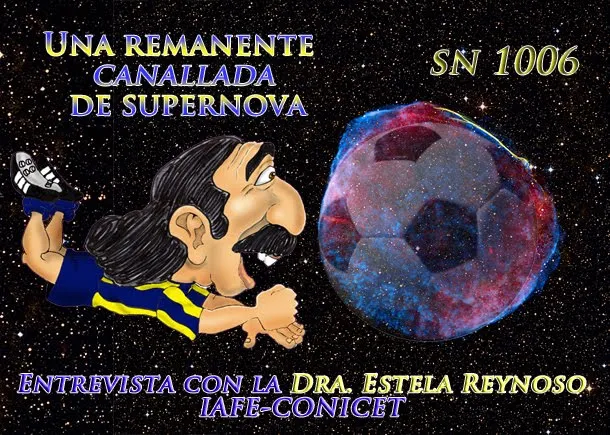
"He died jumping, happy, hugging the boys, outdoors, with the joy of having beaten leprosy for the rest of the centuries!" recounts the brilliant Fontanarrosa in "December 19, 1971" about a fictional Rosario Central fan who dies of joy upon seeing the famous header by Poy.
Perhaps the white dwarf that was part of a binary system 7,200 light-years away thought the same, 965 years earlier, as it launched itself header-first into space as a supernova.
Perhaps Dr. Reynoso, a self-proclaimed "fundamentalist Canalla," who in her youth had to choose between the frequencies of music and those of radiation, decided to dive headfirst into the heart of physics to turn -via Fourier transform- supernova remnants (SNRs) into a tribute to the cosmic leap of the one who debuted for Central in 1965. Around that time, a ring of material began to be detected in radio waves at the position of the supernova seen by the Chinese in the year 1006.
Dr. Reynoso is now studying that SNR, but it's not the first time she has done so. For the IAU meeting in Prague in 2006, the observation of the supernova event was 1000 years old, and for that occasion there was a historical, observational, and theoretical review of the remnant in which the astrophysicist from Rosario participated.
She has also conducted other research on this and other objects in radio waves and is currently preparing a paper together with John Hughes (Rutgers University) and David Moffett (Purman University).
"Now we are giving another twist to these radio observations by analyzing the polarized light emission," she notes.
-Why does this topic arise, why aren't there already polarized light observations of this object?
-There already are, but as new things are discovered about this object, it captures more attention. For example, before it wasn't known that it had very high-energy emission and that generates interest in knowing what's happening there. There is a polarization study, but done with observations from the '80s and although the study is very good and very complete, at this point it can be improved and that's what we have achieved.
-Due to the sensitivity of the instruments.
-Exactly, because instruments and techniques have progressed. That study has data only from the VLA (Very Large Array) and what we did now was take new data from the VLA, but also data from the ATCA (Australian Telescope Compact Array) that I took when I was in Australia. And by combining all that we were able to get maps with much better sensitivity, to see things that weren't seen before. For example, this supernova remnant is formed by two very bright lobes and before it was seen that the magnetic field was radial in the lobes. We now were able to see the complete circle even in the part that is not bright. We were able to see the polarized light and how the magnetic field is. And it turns out we discovered that there it is not radial, but tangential. And what we found is that the magnetic field that is seen is mostly the galactic magnetic field because it is seen with a tendency to be parallel to the galactic plane. We also saw that precisely in the zone that is almost invisible, in radio, is where the magnetic field is tangential, and it is radial in the zones where it is brighter.
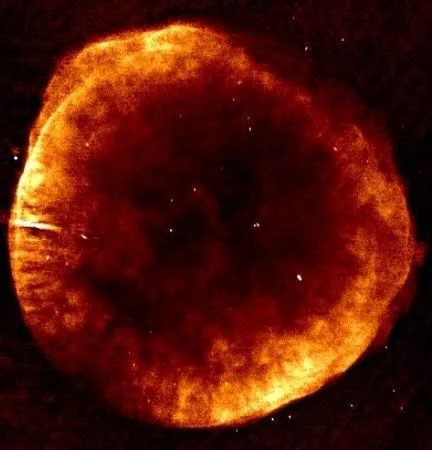
-In this case, the supernova would have occurred in a binary system (Type Ia Supernova). And what is seen is the remnant of that white dwarf that suffered a supernova event. And does the companion still exist?
-It is not known which one it is. It must exist, we assume, but it is not known which one it is.
-And this is at what distance?
-Approximately 2 kiloparsecs. [Approx. 7000 light-years]
-And what else can be said about this latest work in progress?
-On one hand, the orientation of the magnetic fields. On the other hand, it was found that in the zone of the bright lobes the fraction of polarized light is very low, compared to the same fraction in the parts that are almost invisible (in radio). There the fraction is very high, it almost reaches the theoretical value it should have, 70% polarized. And what that is saying is that where the polarization is so high means that the magnetic field is very ordered, there is no turbulence. In the other zone, where the polarization is lower means that there is a lot of turbulence, the magnetic field is very disordered. And it being very disordered means that there are very small zones where the magnetic field is very amplified and precisely that is what is required for particles to accelerate and emit in radio. It's the theory known as diffusive shock acceleration. [See: Measurement of the magnetic field in SN 1006]
-So it agrees with the theory.
-Exactly, it would be providing very strong evidence that the theory is correct.
-That's important.
-It's very important and that is related to the work on Tycho [K.Eriksen et al. 2011, ApJL, 728:L28; arXiv:1101.1454] which is also the study of the same thing.
-So far we have the chosen topic, the collaborators, the observations. The latter are images with a special format, which contain metadata...
-In this case we have a coordinate matrix where each one is assigned an intensity value, but also the value of the polarized intensity. And they can be in a single file or in several.
-How is that data analyzed?
-The data is calibrated with packages that are already made. For each instrument there are packages that optimize the entire calibration process. But then you have to keep processing them, if you want to get more results, and for that you have to write the codes. Often they are not made, I have had to make several.
-So an astrophysicist, besides knowing their specialty, must know English...
-And computing.
-And once you have that data you have to draw conclusions and reach an agreement with the rest of the team and finally write a paper. A paper will always come out, some conclusion will be drawn...
-Sometimes there are works that end up going nowhere. The data may turn out to be insufficient to reach a conclusion or it doesn't yield what one expected.
-And in this case?
-No, in this case the data is very interesting and we are evaluating which publication to send it to so it has impact.
Astrophysicists and Society
-So far you could explain, roughly, how an investigation in astrophysics develops. But society has a particular view of researchers. That's why I found a work of yours on "Astronomy in the Cinema" interesting.
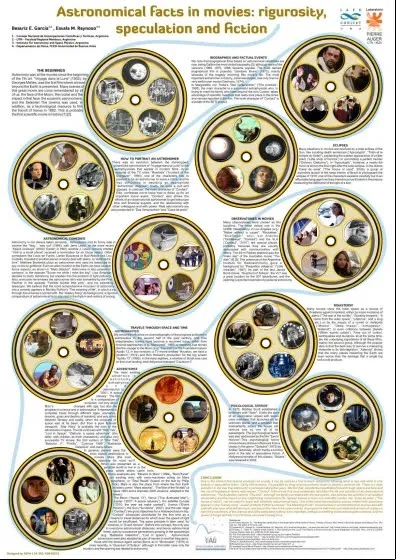
-Precisely we try to see different ways in which astronomy enters the cinema. For example through astronomical objects or phenomena like eclipses and in one part we focus on how an astronomer or astrophysicist is seen from the cinema. And it's interesting to see the evolution there has been, how they were stereotyped at the beginning while now there are more realistic films.
-Stereotypes still exist because it's cinema after all.
-Yes, but the gap isn't that big. For example in a German film, The Promise [Das Versprechen, by Margarethe von Trotta] where the protagonist is an astronomer who gets separated from his family by the Berlin Wall and actually the film is centered on the family drama and in parallel they show him as an astronomer. We are also going to show a section from The Simpsons [Episode 16-Season 14: "Perdonad si añoro el cielo" in Spain and "Reencuentro con el firmamento" in Latin America] where the astronomer [Professor Frink] is shown as a "nerd" and ugly. They talk about light pollution and the astronomer says it's a problem as big as him getting girls...[See in video at 09:10]
(Laughter)
-Right, very stereotyped.
-But taken with humor.
-They also recommend the Brazilian film "House of Sand" (Casa de Areia, by Andrucha Waddington).
-There the protagonists are not astronomers. It's the story of a woman who goes to live in the desert, sees an eclipse and a group of astronomers celebrating that they managed to take a good photograph that would validate the theory of relativity [the deflection of starlight by the sun's gravity. That expedition is real, see note#1].
-And this work you have done with Dr. Beatriz García, with what objective was it done and where will it be presented?
-We did it thinking about outreach activities for the International Year of Astronomy, in 2009, because we like cinema, but due to a matter of available time the preparation of the work kept extending. But we plan to present it at the October meeting of the AAA [54th Meeting of the AAA] and we will try to take it to different places in the country.
-This is presented as a talk.
-Yes, as an oral presentation, but we are going to show some fragments of films where astronomy appears.
-To conclude, a topic related to this is the issue of gender. Have you experienced it?
-I never noticed any difference in treatment for being a woman, not since I entered university. Probably the generation before mine did notice it because the university was full of men and you had to dare. When I entered there were already many women, and that's even though I went to the engineering school.
-And in the professional field?
-Even less. And now as they want to favor women they are even given many more facilities than men.
-Are there other types of biases, like that of origin?
-Yes, I noticed much more discrimination for being from the interior when I came to Buenos Aires.
-Could it be because the porteño thinks they are superior?
-I can't generalize, but I did notice a certain distrust. I felt free of that the first time I went to the VLA because we were all Argentines. Now I think it happens less, because in the place where I am working, the IAFE, there are already many of us from the interior.
Profile
Estela Marta Reynoso holds a Ph.D. in physics from the Universidad Nacional de Rosario. She completed postgraduate studies at the University of Sydney in Australia, is an independent researcher for CONICET and a teacher. Her main topic of interest is supernova remnants and she is part of the IAFE group that studies those objects. Her name gained some notoriety for her participation in an investigation publicized in March of this year about the Tycho SN by Chandra. Reynoso is also a piano teacher and if she didn't dedicate herself to that instrument it was because she passed the entrance exam for physics. But also, she confesses, it would have been difficult for her to drink mate. Finally she dedicated herself to astrophysics and, in particular, to the study at radio wavelengths. And she is also a correspondent for Buenos Aires Canalla, where she mixes her passions for physics and Rosario Central.
Clarification: [The phrases in brackets are my additions and not from the interviewee]
Sources and related links
- Note #1: The South American Demonstration of Einstein's Theories
Jean Einsenstaedt and Antonio Augusto Passos Videira
Ciencia Hoy, Volume 8 - No.44 - JANUARY/FEBRUARY 1998;
http://www.cienciahoy.org.ar/hoy44/demo3.htm - Morphological evidence for azimuthal variations of the cosmic ray ion acceleration at the blast wave of SN 1006
Gamil Cassam-Chenai, John P. Hughes, Estela M. Reynoso (IAFE), Carles Badenes, David Moffett
2008 ApJ 680 1180 DOI: 10.1086/588015
arXiv:0803.0805v1 [astro-ph] - A polarisation study of SN 1006
Estela M. Reynoso, David A. Moffett, John P. Hughes.
About the images
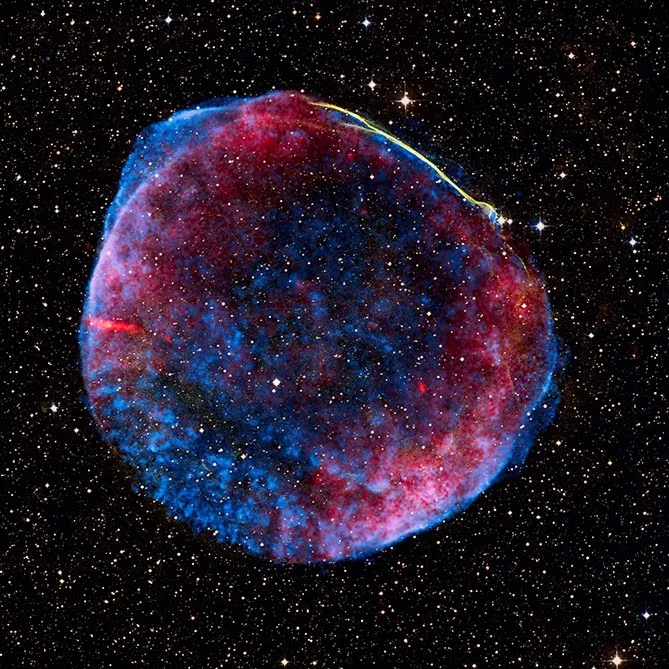
- SN 1006 by Chandra. Credits: Credit: X-ray: NASA/CXC/Rutgers/G.Cassam-Chenaï, J.Hughes et al.; Radio: NRAO/AUI/NSF/GBT/VLA/Dyer, Maddalena & Cornwell; Optical: Middlebury College/F.Winkler, NOAO/AURA/NSF/CTIO Schmidt & DSS
- The first image is a combination of SN 1006 from Chandra, a drawing of a soccer ball from OpenClipArt, and an illustration of Pedro Poy made by the illustrator Gabriel Cuesta, used with his permission. Thanks Gabriel! Visit his site: http://www.gabicuesta.com.ar/