The discovery was made by an international team of astronomers including two from the Australian National University. Their paper in the December 13 edition of Nature describes how the outer Milky Way is a mixture of two distinct components rotating in opposite directions.
The finding proves what astronomers have suspected for 30 years: that the halo of the Milky Way did not assemble all at once, but happened over time.
Daniela Carollo and John Norris, team members, made the discovery after studying 20,000 stars observed by the Sloan Digital Sky Survey (SDSS-II).
"By examining the motions and chemical composition we can see that the halo inner and outer are quite different and probably formed in different ways and at different times," says Carollo, lead author of the report.
"Although it was once considered a single structure, an analysis of the SDSS-II stars shows that the halo is clearly divisible into two components. The finding gives us a clearer picture of the formation of the first objects in our Galaxy and in the entire Universe," she added.
"This conclusively shows that there are two major parts to the halo structure - inner and outer," says Norris. "The inner is a part of the galaxy that is rotating slowly. The part we live in -the Galactic disk- rotates at one rate while the inner component goes in the same direction but much more slowly. The outer halo rotates, albeit slowly, in the opposite direction."
The discovery also reveals that the two halo components have different chemical compositions. According to Carollo, the stars of the inner halo contain three times more heavy elements than the stars of the outer halo.
Professor Norris has spent more than two decades searching for the chemically most primitive stars in the galaxy. These fossils of the early Universe are extremely rare, explains Norris, so finding them remains the classic problem of finding a needle in a haystack. But he adds that the discovery of a chemically distinct outer halo "gives us a better way to search the haystack".
Sources and related links
- Press release from the Australian National University
- Physorg:Discovery shows Milky Way halo is split in two
- Paper:Two stellar components in the halo of the Milky Way,p1020
Daniela Carollo, Timothy C. Beers, Young Sun Lee, Masashi Chiba, John E. Norris, Ronald Wilhelm, Thirupathi Sivarani, Brian Marsteller, Jeffrey A. Munn, Coryn A. L. Bailer-Jones, Paola Re Fiorentin & Donald G. York
doi:10.1038/nature06460
About the images
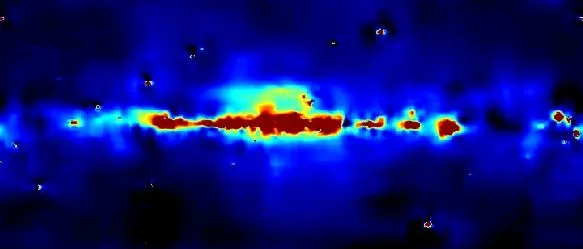
Observatorio.info:The gamma-ray halo of the Milky Way
Credits:D. Dixon(UCR),D. Hartmann (Clemson),E. Kolaczyk (U. Chicago),NASA
Translated by José Calvar. Original version in English.