The 'lifestyles' of 75 neighboring galaxies are illuminated in this poster from the Spitzer Space Telescope. Scientists say this perspective of our cosmic neighborhood provides a valuable insight into the growth process of galaxies at a glance.
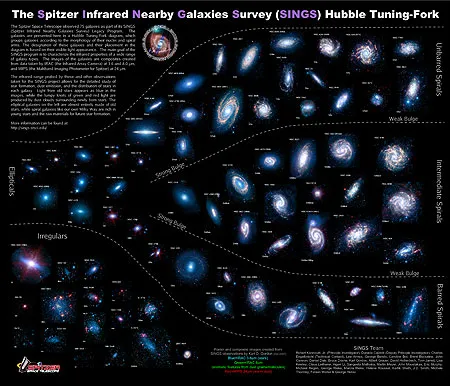
In the past four years, Spitzer has captured in infrared some of the most fascinating galactic neighbors as part of the study called SINGS (acronym for Spitzer Infrared Nearby Galaxy Survey). By understanding the mechanisms that promote and hinder star production in these neighboring galaxies, SINGS astronomers hope to solve the mystery of where galaxies come from and how they developed throughout the history of the Universe.
"Once the SINGS observations were done, I began to wonder how to look at all the galaxies and become aware of the whole picture. The SINGS sample of 75 galaxies was too many to display on a computer monitor and be able to appreciate the spatial details present in the images," says Dr. Karl Gordon, of the Space Telescope Science Institute, a member of the SINGS team.
Finally, Gordon decided to create a poster with 75 galaxies organized by shape - using the galaxy classification system created by astronomer Edwin Hubble in 1925. Due to the shape of the diagram it is also called a 'tuning fork'.
In this structure, elliptical galaxies are on the left side of the poster, on the handle of the tuning fork. They are designated by the letter 'E' and carry a number from 0 to 7. An 'E0' galaxy looks round, while an E7 is very long and thin.
Spiral galaxies are located on the right side of the poster, on the two 'tines' of the tuning fork. The top part is composed of regular spiral galaxies and are identified by the letter 'S'. Barred spirals are in the bottom part and are denoted as 'SB'. The letters 'a', 'b', and 'c' indicate how tightly wound the galaxy's arms are. An 'Sa' galaxy has very tightly wound arms while an 'Sc' has a less pronounced central concentration.
"Irregular galaxies were not represented in Hubble's original diagram, so we organized them in the lower-left part of the poster," says Gordon.
In the image, blue colors reveal light from old populations of stars. Greenish tints represent organic molecules (Polycyclic Aromatic Hydrocarbons), while red clusters show clouds of hot dust and gas heated by radiation from newborn stars.
"One of the most striking things about placing these galaxies in the tuning fork model is that you can quickly see that elliptical galaxies are bluer, which means they are made primarily of older stars. On the other hand, spirals have green and red tints, indicating the presence of dust and star formation," says Dr. Robert Kennicutt, also a team member.
Kennicutt points out that red tints in galaxies like NGC 3265 show that not all ellipticals lack dust and star formation, and blue spiral galaxies like NGC 4826, on the other hand, reveal that some spirals have a large population of old stars.
The images in this poster are a three-color composite with wavelengths of 3.6 microns for blue, 8.0 for green, and 24 microns for red.
Sources and related links
- Note on the Spitzer site
- Formation and evolution of galaxies
About the images
SINGS Hubble Tuning Fork Poster
NASA/JPL-Caltech/K. Gordon (Space Telescope Science Institute) and the SINGS team.