A study suggests that the acceleration of the expansion of the Universe is not real, but that Time is slowing down!
The idea was proposed by Professor José Senovilla, Marc Mars and Raül Vera of the University of the Basque Country in Bilbao, and the University of Salamanca.
The motivation for this radical idea is to provide an alternative explanation for "dark energy", the mysterious antigravitational force proposed to explain a cosmic phenomenon related to supernovae.
A decade ago, astronomers noticed that distant supernovae seem to be moving faster than expected. A group of astronomers led by Adam Riess and Saul Perlmutter discovered the Acceleration of the expansion of the universe by studying type Ia supernovae, the Supernova Cosmology Project.
Actually, the study intended to evaluate at what rate the Universe was decelerating, which was the prevailing idea under the assumption that the expansion of the Universe should be slowing down due to gravity. What they found was the complete opposite: the Universe is expanding at an accelerating rate.
Dark energy was suggested as a repulsive force, with effects similar to those proposed by Einstein in his famous Cosmological Constant, which accelerates the expansion.
The new proposal, which will be published in Physical Review D, completely sets aside dark energy.
On the contrary, Senovilla says that the appearance of acceleration is caused by time itself gradually slowing down.
"We are not saying that the expansion of the Universe itself is an illusion. What we are saying is that the acceleration of the expansion could be an illusion, that is, the possibility that the expansion has increased its rate."
On the contrary, if time is gradually stopping "but we naively continue using our equations to derive the changes of the expansion with respect to a 'standard flow of time', then the models built in our report show that an effective acceleration rate of the expansion takes place."
Although the change would be infinitesimal from an ordinary human point of view, from a cosmological perspective this temporal slowdown could be measured.
The group based their idea on a particular variant of superstring theory in which our Universe is confined to the surface of a membrane or brane, floating in a higher-dimensional space called the bulk.
According to the proposed idea, within several billion years, time would stop and with it, everything else. "Everything would freeze, like a snapshot of an instant."
However, Senovilla clarifies that the group assumes time is one-dimensional. Itzhak Bars, from the University of Southern California in Los Angeles, has suggested that there are two temporal dimensions.
Although the idea may sound outlandish, the LHC could provide evidence of extra dimensions in the Universe and thus this kind of theory would move from the realm of mere speculation to the prevailing conventional science.
Meanwhile, in Argentina, the clocks will be moved forward one hour to favor energy savings...
Sources and related links
- Time is running out - literally, says scientist, by Tom Chivers and Roger Highfield, Telegraph
- The Supernova Cosmology Project
- New interview with Peter Lynds
- Distant Supernovae Indicate Ever-Expanding Universe
- High-Z Team
About the images
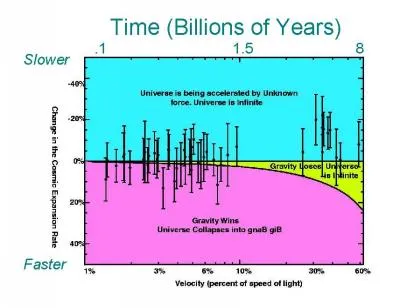
Graph from the High-Z Team
The graph shows supernova data. It shows the distances (or equivalent time since the SN explosion), the changes in the expansion rate (the y-axis) and the velocity (as a percentage of the speed of light).
As can be seen, the points do not show a Universe decelerating enough to have a gnaB giB (Big Bang backwards, a collapse or contraction of the Universe, lilac-colored area). On the contrary, it is accelerating (light blue area).