A high rate of star formation discovered in a distant galaxy shows that galaxies in the early Universe developed either faster or in a different way than astronomers had thought.
"This galaxy is forming stars at an incredible rate," says Wei-Hao Wang, an astronomer at the National Radio Astronomy Observatory (NRAO) in New Mexico. The galaxy is forming the equivalent of 4,000 Suns per year. This is thousands of times more violent than in our Milky Way.
It is GOODS 850-5, 12 billion light-years from Earth, so it is seen as the galaxy was only 1.5 billion years after the Big Bang. Wang and his colleagues made the observations using the Smithsonian Submillimeter Array (SMA) in Hawaii.
The young stars of the galaxy were covered by dust that heated up and emitted strong infrared light. Since the galaxy is at a great distance, the infrared waves were stretched by the expansion of the Universe into submillimeter radio waves that are seen by the SMA.
The dust formed from heavy elements that formed in the cores of the first stars. This indicates, according to Wang, that a significant number of stars formed, then expelled those heavy elements into interstellar space through supernova explosions and stellar winds.
"This means that future telescopes like ALMA will be able to reveal many more galaxies and give us a more complete picture of star formation in the early Universe," he added.
Lennox Cowie of the University of Hawaii says, "We have found in the last decade that most star formation in the Universe occurs in large dusty galaxies, but we have always expected that early star formation was dominated by smaller and less obscured galaxies. Now it seems that even at very early times there would be the same large, dusty star-forming galaxies. It's quite a surprise."
Astronomers believe that large galaxies originally formed through the merger of smaller objects. Seeing a large galaxy like GOODS 850-5 forming stars so rapidly at such early times in the history of the Universe is a surprise. "Either the mergers that formed the galaxy happened faster than thought or some other process produced the galaxy," says Wang.
The scientists published their findings in the December 1st issue of Astrophysical Journal.
Sources and related links
- Press release at CfA: New View of Distant Galaxy Reveals Furious Star Formation
- NRAO: New View of Distant Galaxy Reveals Furious Star Formation
- Paper: GOODS 850‐5: A z>4 Galaxy Discovered in the Submillimeter?
Wei‐Hao Wang, Lennox L. Cowie, Jennifer van Saders, Amy J. Barger, and Jonathan P. Williams
Received: 2007 July 22 Accepted: 2007 October 8
The Astrophysical Journal Letters. Volume 670, Issue 2, Page L89–L92, Dec 2007 | DOI: 10.1086/524221
About the images
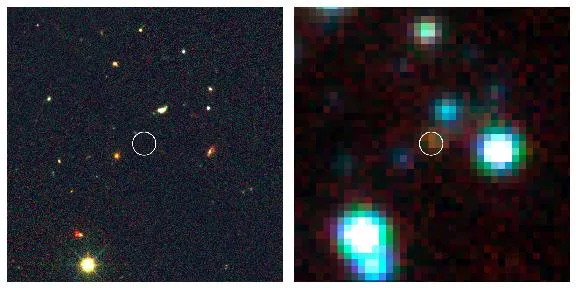
Images in visible light, left (from HST) and infrared, right (from Spitzer). The circles indicate the location of GOODS 850-5
Credit: Wang et al., STScI, Spitzer, NASA, NRAO/AUI/NSF