Using ESO's VLT, a team of astronomers discovered a rare case of a triple galaxy merger. The system, which they call "The Bird," is composed of two massive spiral galaxies and a third irregular galaxy.
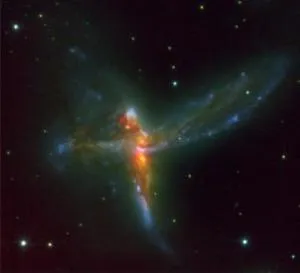
The galaxy ESO 593-IG 008 or IRAS 19115-2124 was previously known as an interacting pair of galaxies 650 million light-years away. But the surprise came with observations made with the NACO instrument of ESO's VLT Telescope, which obtained finer details.
Beneath the chaotic appearance of Hubble's optical images, the NACO images show two unmistakable galaxies, one a barred spiral and the other more irregular.
The surprise lay in the clear identification of a third, clearly separate, irregular and massive galaxy that appears to be forming stars at a frantic rate.
"Examples of mergers of three galaxies of similar sizes are rare," says Petri Väisänen, author of the paper reporting the results.
Given the shape of the system, it was named "The Bird," with the "head" being the third component and the "heart" and "body" the two large galactic nuclei in the midst of gravitational tugs, the "wings." The latter extends over 100,000 light-years, the size of our own Milky Way.
Optical spectroscopy with the new Southern African Large Telescope and archival data from Spitzer confirmed the separate nature of the "head," but also added more surprises. The "head" and the most important parts of the "bird" are moving at over 400 km/s (1.4 million km/h!). Observing such velocities is very rare in galaxy mergers. Furthermore, the "head" appears to be the main source of infrared light in the system, although it is the smallest of the three galaxies.
"It seems that NACO captured the action right at the moment of the first fast flyby of the "head" galaxy through the system consisting of the other two galaxies," adds Seppo Mattila, a team member.
The "head" is forming stars violently, at a rate close to 200 solar masses per year, while the other two appear to be in a quieter period of interaction-induced star formation.
The system belongs to the prestigious family of luminous infrared galaxies, with a luminosity close to one hundred billion times that of the Sun. This family of galaxies is thought to signal important events in galactic evolution, such as mergers that trigger star formation and perhaps ultimately lead to the formation of a single elliptical galaxy.
The discoveries will appear in an upcoming issue of Monthly Notices of the Royal Astronomical Society.
Sources and related links
- Cosmic Bird? Triple Cosmic Collision Of Galaxies Stuns Astronomers. ScienceDaily. Retrieved December 21, 2007
- "Adaptive optics imaging and optical spectroscopy of a multiple merger in a luminous infrared galaxy"
About the images
Credit: ESO, final color by Henri Boffin