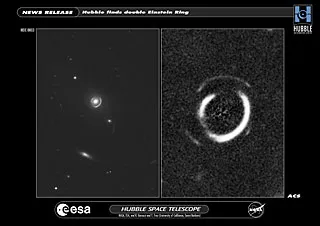
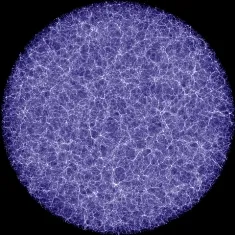
Scientists believe that a quantum leap in computing power and the development of powerful new telescopes will soon unveil the 'cosmic web,' a theory in which the Universe is held together by invisible filaments of dark matter.
In a series of articles in the January 4 issue of Science, astrophysicists explain how new technologies and experiments to be launched in the coming years will open a new window onto the origins and complexities of the Universe.
Current tools have made it possible to get an approximate picture of how the Universe was born in the Big Bang and a mere understanding of the mysteries of dark matter.
But they are not precise enough to map the cosmic web that holds the 100 billion bright galaxies in the known Universe or reveal details of how galaxies form and interact.
According to the authors, several projects will change that.
"We are about to make tremendous progress thanks to the new observatories (being planned) and advances in supercomputing," explained Claude-Andre Faucher-Giguere, author of one of the articles.
"A long time ago, the Universe was full of neutral hydrogen, but at some point the first stars formed and the Universe went from neutral to ionized and the neutral hydrogen disappeared," explains the scientist.
Low-frequency observatories being developed and the powerful James Webb Space Telescope to be launched in 2013 will look for signs of neutral hydrogen.
Another key project is the GAIA Experiment, which will measure and map the motions of more than a billion stars in our galaxy, in 2011.
Another frontier where much progress is expected is the discovery of the missing baryons, the atomic nuclei of which stars, planets, and people are made.
Astrophysicists can currently account for only half of the baryonic mass that should be present under the standard model of the Universe. The remainder is believed to be hidden in a web of hot gas in the intergalactic medium.
"Finding the missing baryons and thus making a complete inventory is crucial to validating our standard cosmological model," writes author Fabrizio Nicastro of the Harvard-Smithsonian Center.
The articles in the special issue of Science are:
Cosmic Web
Warp and Woof
David Voss and Robert Coontz
Science 4 January 2008: 46.
DOI: 10.1126/science.319.5859.46
News
NEWS: Untangling the Celestial Strings
Adrian Cho
Science 4 January 2008: 47-49.
DOI: 10.1126/science.319.5859.47
Perspectives
The Cosmic Web in Our Own Backyard
Rodrigo A. Ibata and Geraint F. Lewis
Science 4 January 2008: 50-52.
DOI: 10.1126/science.1152008
Numerical Simulations Unravel the Cosmic Web
Claude-André Faucher-Giguère, Adam Lidz, and Lars Hernquist
Science 4 January 2008: 52-55.
DOI: 10.1126/science.1151476
Missing Baryons and the Warm-Hot Intergalactic Medium
Fabrizio Nicastro, Smita Mathur, and Martin Elvis
Science 4 January 2008: 55-57.
DOI: 10.1126/science.1151400
Sources and related links
- -Discovery News:Computer Power Promises to Reveal Cosmos, by Mira Oberman
- -Science, 4-01-2007, Vol 319, No.5859
- -Physorg:Quantum leap in technology to unravel 'cosmic web' of universe
About the images
Credit:Science