A large part of the gaseous mass of the Universe is tied up in a tangle of cosmic filaments stretching for hundreds of millions of light-years, according to a new computational study by a team led by the University of Colorado at Boulder.
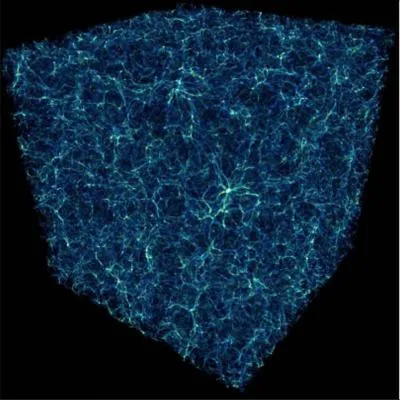
The study indicates that a significant portion of the gas is in filaments—which connect galaxy clusters—hidden from direct observation in enormous gas clouds in the so-called Warm-Hot Intergalactic Medium (WHIM), according to Jack Burns from the department of astrophysical and planetary sciences of the University.
The team performed one of the largest cosmological simulations, compiling 2.5 percent of the visible Universe into a computational model to simulate a region of more than 1.5 billion light-years.
A paper on the topic will be published in the December 10 edition of Astrophysical Journal.
It took the scientists nearly a decade to produce the extraordinary computer code to run the simulation, which incorporated virtually all the physical conditions of the Universe, going back in time almost to the Big Bang, said Burns. The simulation—which uses advanced numerical techniques to focus on interesting structures of the Universe—modeled the motion of matter as it collapsed due to gravity and became dense enough to form cosmic filaments and galactic structures.
"We see this as a real breakthrough in terms of technology and science," said Burns. "We believe this effort provides a significant step forward in understanding the fundamental constituents of the Universe."
According to the standard cosmological model, the Universe consists of about 25% dark matter and 70% dark energy with only 5% normal matter. The latter consists mainly of baryons—hydrogen, helium, and heavy elements—and observations show that about 40% of the baryons are currently "missing." Many astrophysicists believe the missing baryons are in the WHIM, as Burns explains.
"In the coming years, I think these filaments could be detectable in the WHIM using the new telescopes. We believe that by starting to see those filaments and understand their nature, we will learn more about the missing baryons in the Universe."
Two of the key telescopes astrophysicists will use in the search for the WHIM are the 10m South Pole Telescope in Antarctica and the 25m Cornell-Caltech Atacama or CCAT, which is being built in the Atacama Desert in Chile.
The CCAT will gather sub-millimeter wave radiation, which is longer than infrared but shorter than radio. It will allow astronomers to look back in time when the first galaxies were appearing—only one billion years after the Big Bang—allowing an understanding of the process of their formation.
The South Pole Telescope captures in millimeter, sub-millimeter, and microwave wavelengths of the spectrum and is used to search, among other things, for the cosmic microwave background radiation. They hope to be able to estimate the temperature of this radiation as it travels through the WHIM.
The University of Colorado team ran the computer code for a total of 500,000 processor hours at two supercomputing centers—in San Diego and at the University of Illinois at Urbana. About 60 terabytes of data were generated during the calculations. According to Burns, the sophisticated code used is similar in some aspects to that used in complex simulations of Earth's atmosphere and climate change, since both research efforts focus heavily on fluid dynamics.
Sources and related links
- CU-Boulder supercomputer simulation of universe may help in search for missing matter
- University of Colorado
- A telescope to explore the origins of the universe
- A piece of the Universe got lost, again
About the images
The image is an illustration of a portion of the Universe simulation showing a region about 1.5 billion light-years on a side. The bright object at the center is a galaxy cluster millions of billions of times the mass of the Sun. Amid the filaments, which store most of the mass of the Universe, there are giant, spherical voids almost empty of matter.
Credit: University of Colorado at Boulder.
Related notes in this blog on "computer simulation"