After midnight on December 13 will be the best time to observe the peak of the Geminid meteor shower.
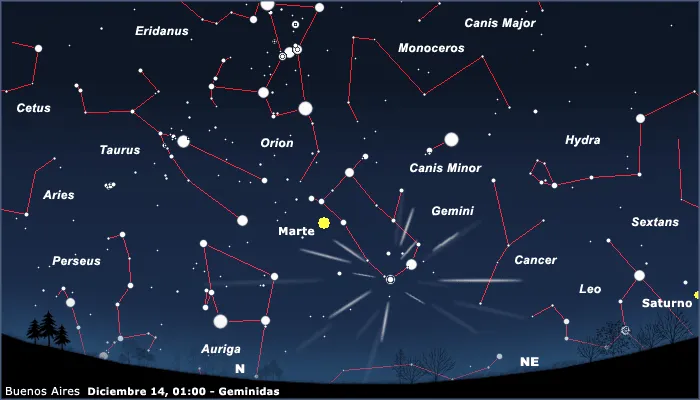
It will be the best shooting star show of 2007: during the night from Thursday to Friday, the famous Geminid meteor shower will reach its maximum intensity. Far from cities, in places with dark skies, dozens of meteors shooting stars can be observed throughout the early morning. All with the naked eye. In Buenos Aires and other large urban centers, light pollution will dim part of the phenomenon, but anyway, it will be worth going out to look at the sky. In cities, the best places to enjoy this celestial show will be open-air rooftops. On the other hand, on this occasion, conditions will be ideal: there will be good weather in a large part of the country, and the Moon will not interfere with its brightness.
The "Geminids" are coming
There are about 40 meteor showers per year, but most are very weak. And in general, the Geminid meteor shower is usually the richest and most reliable of all (only surpassed by rare episodes of the "Leonids"). The curious phenomenon bears that name because, due to a matter of perspective, the meteors seem to sprout from the region of the sky occupied by the constellation Gemini. And it originates from particles from the strange Phaethon, a dead comet. The "Geminids" are bright white shooting stars, although some are yellow, red or green. This year conditions are ideal, not only due to good meteorological prospects (there will be little cloudiness), but also because the Moon will not bother with its glow: our satellite will set below the horizon around 23 hours, that is, right at the beginning of the phenomenon, leaving the sky dark for the rest of the night.
When, how and where to observe the Geminids?
When: although it is true that the phenomenon extends from December 7 to 17, its maximum activity will occur during the night from Thursday 13 to Friday 14, between 23 h and 4:30 h in the morning, when it will begin to get light. Anyway, all estimates indicate that the show will also be interesting on the night from Friday to Saturday.
How: these phenomena are ideal to see with the naked eye. Telescopes or binoculars are not needed, instruments that would only narrow the field of view. You must locate yourself in a dark place, in the open air and without nearby lights. In cities, the best places are rooftops.
Where to look: you must look towards the highest part of the sky (the zenith), and preferably in the North direction. For comfort, and given the duration of the phenomenon, the ideal is to lie back on a deck chair or a reclining chair.
"Shooting stars"
We have all seen "shooting stars," those very fast traces of light that sometimes cross the night sky from side to side. The curious thing is that, despite their name, they have nothing to do with stars: they are just rocky particles that enter the atmosphere at tens of thousands of kilometers per hour, and due to friction, they heat up and ionize the air, generating fast flashes of light (at about 80 kilometers in height). On a common night, a few can be seen. However, from time to time, when the Earth passes through the "rivers" of dust left by some comets, the number of particles falling on the planet is much greater. And then, we have a "meteor shower"
How many shooting stars?
Although it is true that this powerful and reliable meteor shower favors the Northern Hemisphere (where the constellation Gemini appears very high in the sky), from Argentina we will be able to enjoy a good show. But that will depend crucially on our observation location: in cities many fewer shooting stars will be seen than in the countryside or in other areas far from urban centers. It's simple: the darker the sky, the greater the number of observable meteors.
Numbers? Taking into account the experience of different observers from the Planetario de la Ciudad de Buenos Aires in previous episodes (from 1997 to date), it is very likely that in the early morning of Friday 14 (especially between 1:00 and 4:00 h), far from cities, we can see between 30 and 40 Geminid meteors per hour. In large urban centers the figure may be around 10 meteors per hour. In any case, it will be worth staying up late: if the clouds do not interfere, the night from Thursday to Friday (and to a lesser extent, from Friday to Saturday) the Geminid meteors will once again dazzle us with their brightness and color, justifying their well-deserved astronomical fame.
Sources and related links
- Planetario Galileo Galilei
- Sur Astronómico
About the images
Map by Conrado Kurtz, Enzo de Bernardini: Sur Astronómico