NASA's Hubble Space Telescope took this image of the red planet when it was only 88 million kilometers away.
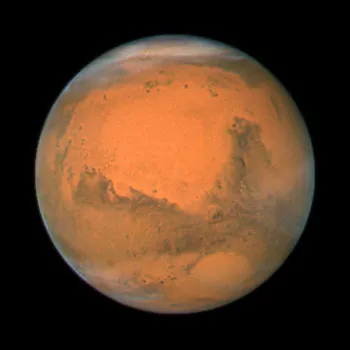
The image color is the result of combining a series of exposures taken within 36 hours before the opposition with the WFPC 2 camera. Mars will be closest to Earth on December 18 at 11:45 p.m. Universal Time.
After midnight on 12/18, Mars will be visible at the moment of closest approach to Earth, located at 0.5893 Astronomical Units. It will show an apparent size of 15.9 arcseconds, the largest in the next 9 years.
Mars and Earth have a "close encounter" every 26 months. These periodic encounters are due to differences in the planets' orbits. Earth goes around the Sun twice as fast as Mars. Both planets have elliptical orbits so their close encounters are not always at the same distance. In its close encounter with Earth in 2003, for example, Mars was 32 million kilometers closer than it is in 2007, so it looked larger from our planet.
The two dark regions that dominate the area just below the planet's equator are known areas. The large triangular shape on the right is Syrtis Major. On the left is Sinus Meridani. One of NASA's rovers, "Opportunity," landed west of this region in January 2004. At the intersection of these areas is the prominent Huygens crater with a diameter of 450 kilometers. South of the crater is Hellas with a diameter of 1760 km and a depth of about 8 km. Hellas formed billions of years ago when an asteroid collided with the surface of the red planet.
In this approach, Mars appears free of dust storms, although there are significant clouds visible in the polar caps. The resolution is 21 kilometers per pixel.
Sources and related links
About the images
Image credit:
NASA, ESA, the Hubble Heritage Team (STScI/AURA), J. Bell (Cornell University), and M. Wolff (Space Science Institute, Boulder)
More images accompany the HubbleSite press release.