New research suggests that Earth's natural satellite is 30 million years younger than previously assumed and that it formed from a chunk of our planet and not from the collision of a Mars-sized body that impacted our planet billions of years ago.
The violent impact was thought to have occurred 30 million years after the solar system began to condense from a disk of gas and dust 4,567 million years ago. The event, it was thought, melted Earth, generating a magma ocean that covered the planet and allowed iron and other metals to sink to the center, forming a core.
At the same time, the Moon would have formed from the gathering of debris from a disk of matter generated by the collision of a Mars-sized object with our planet.
But new research led by Mathieu Touboul (of the Swiss Federal Institute of Technology) suggests a different scenario. The researchers based their analyses on studies of a tungsten isotope in lunar rocks.
That isotope, tungsten-182, is produced by the decay of two others, hafnium-182 -whose half-life is 9 million years- and tantalum-182, which is not an intrinsic component of the Moon; it forms when energetic charged particles from space, cosmic rays, strike the lunar surface.
Previous estimates of the Moon's age based their measurements on tungsten but without subtracting the effect of tantalum decay. "It is crucial to remove all the tungsten-182 produced by cosmic rays," says Touboul.
When the team accounted for tantalum, they found that the giant impact had to have occurred at least 50 million years after the solar system began to form and that the Moon completed its formation in the following 10 million years -about 30 million years later than thought.
This implies that rocky planets, like Earth and Mars, took longer to form from the collision of small "planetesimals" than previously believed. "The age of the Moon is also the age of Earth because the giant impact that formed the Moon was the last major event in Earth's formation," says the scientist.
Alan Brandon, of Johnson Space Center, adds: "It means that Earth and Mars took at least 50 million years, and possibly hundreds of millions of years, to reach their final masses."
The researchers also found that the Moon's composition appears identical to that of Earth's mantle, so "a large part of the Moon must have come from the proto-Earth," says Brandon.
"I think models of lunar formation will have to be redone to try to explain why Earth and the Moon have such similar compositions."
The new work suggests that the Moon formed at least 16 million years after the formation of Earth's core. That raises the question of how the iron-rich core melted in the absence of a magma ocean produced by the Moon-forming impact.
"It could be that there were several generations of magma oceans on Earth," speculates Brandon.
Sources and related links
Moon is younger and more Earth-like than thought
Nature:Planetary science: A younger Moon(vol 450, p 1169 and 1206),Alan Brandon |doi:10.1038/4501169a
Late formation and prolonged differentiation of the Moon inferred from W isotopes in lunar metals, M. Touboul, T. Kleine, B. Bourdon, H. Palme & R. Wieler
Nature 450, 1206-1209 (20 December 2007) |doi:10.1038/nature06428
About the images
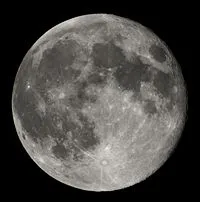
View of the full moon from Hamois, Belgium.
Credit:Luc Viatour, Wikimedia Commons.