According to a new study, 4 billion years ago, these two outer gas giants may have exchanged positions in the Solar System.
Quick: What is the order of the planets in the solar system? Need help? Perhaps this mnemonic rule rings a bell: "Muchas Veces Te Miro Julieta,Sos Una Nena Paqueta". It's useful for remembering the planets today (even though Pluto is now considered a dwarf planet), but it wouldn't have worked in the past because the planets were not always in the current order. Four billion years ago, Uranus and Neptune swapped places.
This is the result of recent work by Steve Desch, an assistant professor in the School of Earth and Space Exploration at Arizona State University. The work appears this week in Astrophysical Journal.
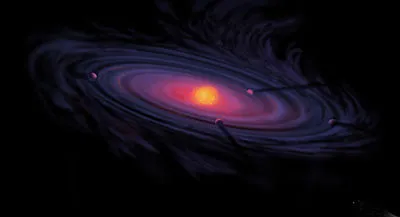
Desch based his conclusions on his calculations of the surface density of the solar nebula. The Solar Nebula is the disk of gas and dust from which all the planets formed. This surface density - or mass per area - of the protoplanetary disk is a fundamental quantity needed to calculate everything, from how fast planets grow to the types of chemicals they contain.
It is very difficult to observe the surface density in protoplanetary disks forming solar systems today, because they are very far away and because most observations only detect dust. So for the last 30 years most researchers have relied on an estimate of the surface density called the Minimum Mass Solar Nebula. The idea is simple: take the rocky component of each planet, add hydrogen and helium until it matches the composition of the Sun, and spread that mass over the area of each planet's orbit. This Minimum Mass predicts disks with a mass not very different from what we can observe in forming solar systems. But it also predicts a low density, with the mass too spread out to form planets quickly.
"I was thinking about planet formation and noticed that current models fail to predict how Jupiter could have grown to its current size within the lifetime of the solar nebula. Given Jupiter's composition and size, models predict it would take several million years to form and billions of years for Uranus and Neptune - but our solar system is not that old," says Desch.
Another model is the one known as Nice, after the city in France where it was developed. It is based on sophisticated numerical calculations of planetary orbits over millions of years. It explains several aspects about the orbits of Jupiter, Saturn, Uranus and Neptune, as well as comets in the Kuiper belt, by assuming the giant planets formed much closer together than they are today. Neptune, for example, would have formed at less than half its current distance from the Sun. And in 50% of the simulations, Uranus and Neptune swapped places.
Desch noted that the Nice model implies that the mass of the solar system was more tightly packed than the Minimum Mass Solar Nebula assumed. By spreading the masses of the planets over their original orbits, as predicted by the Nice model, he found a very smooth variation of surface density with distance from the Sun, but only if Uranus and Neptune had indeed swapped places.
The findings have other implications. "The surface density of the solar nebula is not what we originally thought, it is much higher, and it has implications for where planets form and how fast they grow. A higher density means Uranus and Neptune formed closer and faster, in just 10 million years. That's important because those planets contain a lot of hydrogen and helium and observations of other protoplanetary disks show those gases don't last more than 10 million years."
Besides demonstrating for the first time that all the giant planets can grow within the lifetime of the solar nebula, Desch also discovered the reason behind the sharp variation with distance from the Sun. "The mass distribution falls off very steeply because the outer edge is constantly being boiled away through the process of photoevaporation, by ultraviolet radiation from nearby massive stars."
So it seems that 4 billion years ago, the rule for remembering should have been "Muchas Veces Te Miro Julieta,Sos Nena una Paqueta."
"This reminds us that the solar system is a dynamic place. For the first 650 million years of the solar system, Neptune was closer to the Sun than Uranus - that's 15% of solar system history. It looks completely different from how we see it today," Desch concludes.
Sources and related links
- Solving solar system quandaries is simple: Just flip-flop the position of Uranus and Neptune
- Mass Distribution and Planet Formation in the Solar Nebula
- Formation and evolution of the Solar System
About the images
Artist's conception of a protoplanetary disk. Wikipedia.