Just in time for the holidays, the XMM-Newton X-ray observatory discovered a huge cloud of high-temperature gas in the Orion Nebula, whose shape could resemble a Santa Claus.
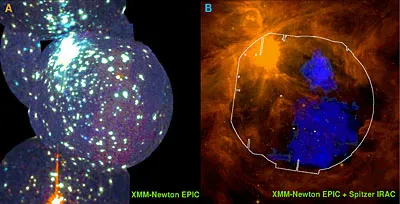
The Orion Nebula is the closest star-forming region that contains stars much more massive than the Sun. The cloud discovered by XMM is composed of winds from those massive stars that are heated to millions of degrees.
"There is one particular star that dominates the nebula," says Manuel Güdel of the Paul Scherrer Institute in Switzerland, who leads the team that made the discovery. The star in question is theta1 Orionis C, a giant star about 40 times the mass of our Sun, with a surface temperature of 40,000ºC. The author and his colleagues think that the violent collision between the winds of this star and the surrounding dense gas is responsible for the discovered gas cloud.
The high-temperature gas fills a region of the nebula that appears to be a large cavity in optical and infrared images. The new observations taken by the EPIC camera on XMM-Newton suggest that astronomers are seeing only a particular portion of the gas. The X-rays from this portion escape the absorption of the cold gas that covers much of the front of the nebula.
The presence of hot gas in a fairly common nebula like Orion is surprising. Although theory predicts these hot gas clouds, previous observations suggested that a large number of massive stars or supernova explosions were required. The new observations show that a smaller collection of massive stars can produce hot gas as well.
Throughout the galaxy there are many star-forming regions similar to the Orion Nebula, so there should be a network of channels and bubbles being filled by the hot gas that seeps from the various regions. "This is another possible way to enrich the interstellar medium. You don't have to wait for a surprising supernova explosion. You can do it with just one or two massive stars over millions of years," says Güdel.
The team now plans to obtain new observations to determine how the gas flows out of the nebula. In particular, they wish to see if it connects with a giant bubble created by supernova explosions from previous generations of massive stars.
The paper reporting the discovery is titled: "A million-degree plasma pervading the extended Orion nebula" and appears in Science Express, the online version of the journal Science, on November 29.
The paper was written by M. Güdel, K. Briggs T. Montmerle, M. Audard, L. Rebull and S. Skinner.
Sources and related links
Note on ESA
Image: Panel A: XMM-Newton EPIC (Guedel et al.), Panel B: AAAS/Science (ESA XMM-Newton and NASA Spitzer data)