The American Association of Physics Teachers, or AAPT, announced that the renowned astrophysicist Vera Rubin, who confirmed the existence of dark matter, has been selected to receive the 2008 Richtmyer Award. Rubin belongs to the terrestrial magnetism department of the Carnegie Institution of Washington.
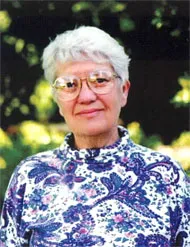
The award is for her "outstanding contribution to physics and the effective communication of those contributions to physics educators."
Richard Meserve, president of Carnegie, noted that "Vera Rubin is a national treasure. She is an accomplished astronomer and a wonderful role model for young scientists. She brings prestige to Carnegie and we congratulate her on this award."
The award will be presented at the AAPT winter meeting, on January 22 in Baltimore. The award has been given annually since 1941, in memory of Floyd Richtmyer, a physicist, teacher and administrator who founded and chaired the AAPT.
Vera Rubin and a paradigm shift
Whenever I can, I recommend Dennis Overbye's book "Lonely Hearts of the Cosmos". In it, several pages are dedicated to the award-winning astronomer.
Vera Rubin was in full flight when she discovered dark matter. Problems and controversies had marked her career, due in part to being a woman and in part to being a brilliant woman. All she wanted was to observe galaxies in peace, but she seemed to have an infallible gift for stumbling upon disturbing observations.
Rubin does not seem like a person who likes to create problems. She is a short woman with a round face and white hair cut in a brush cut. Rubin is a grandmother and speaks simply. She grew up in Washington and became fascinated by astronomy while watching the stars from her bedroom window. Rubin studied at Vassar and her graduating class was that of 1948, immortalized in Mary McCarthy's famous novel, The Group.
The author continues recounting her work in astronomy alongside Kent Ford, Thonnard and Burstein in trying to measure the mass of galaxies using their rotation speeds, with a brand-new spectrograph.
They started with M31, Andromeda, and obtained a flat rotation curve. But they didn't think it was a problem of matter distribution. They then continued making measurements of galaxies and ran into the fact that they got the same results as with M31.
"Nobody told us that all matter radiates," said Rubin in her blunt style, "it was a simple assumption of ours."
In the history of astronomy—in the history of science—there have been radical shifts in the prevailing view, paradigm shifts, such as moving from geocentrism to the notion of heliocentrism, from a static Universe to an expanding Universe, etc.
If you ask me, the greatest modern astronomical paradigm shift is that the matter that composes it is not normal, shining matter. And we owe it in large part to Vera Rubin.
Sources and related links
- Note on EurekAlert
- When You Are Stars
- History of women in astronomy
- Related notes