Four of the most powerful telescopes revealed a small ultracool star with great magnetic activity.
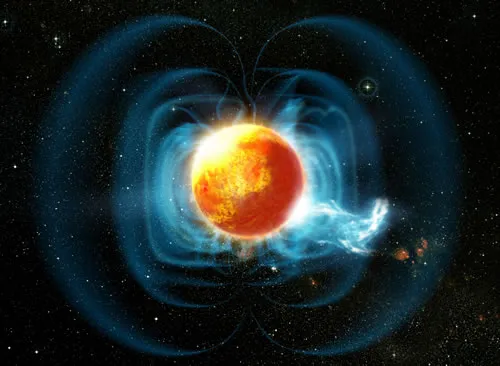
Simultaneous observations made by four of the most powerful telescopes on the ground and in orbit revealed an unusual active magnetic field in the ultracool dwarf star TVLM513-46546. A team of astronomers, led by Dr. Edo Berger of Carnegie-Princeton, is using these observations to explain the activities of this M-type dwarf (see stellar classification) that lies 35 light-years away in the constellation Bootes.
The observations combined radio data from the VLA, optical spectrum from the Gemini North telescope, ultraviolet images from the Swift satellite and X-rays from the Chandra Observatory. The study is part of a program seeking the origins of magnetic fields in cool dwarfs, stars that astronomers always assumed were simple and quiet.
The star has a regular radio emission that is interrupted by one-minute bursts that come from collisions of the magnetic field in the star's corona. The annihilation of magnetic energy produces giant short-circuits. The team also observed a burst and X-ray emissions.
Also for the first time the group charted an hydrogen-alpha emission that is periodic and comes from a large hot zone. The two-hour period of the emission agrees with the star's rotation period.
Objects like this star should have either little or no magnetic activity. The complicated field and the hot zone indicate some activity beneath the stellar surface or the existence of some as yet undiscovered companion.
Like other cool dwarfs, TVLM513-46546 is an M-type star with a surface temperature below 2400 K (2127 Celsius) and a mass of only 8 to 10% of our Sun. The star's luminosity is only 0.02% that of the Sun, which is a G-type star with an average surface temperature of 6000K.
In the Sun, the magnetic field is produced by a dynamo that arises from a complex heat transfer from the center to the surface by radiation and convection. In contrast, a cool dwarf star transports heat only by convection, like boiling water in a pot. Such a structure, it was predicted, would generate a very basic magnetic field, perhaps more similar to Earth's than to the complex fields we see on the Sun.
To study whether the star is a rarity or a prototype of a cool dwarf, the researchers plan to continue observations of other similar stars. Berger notes that he would like to have more observations in search of a possible companion.
The results will be published in the February 10, 2008 issue of Astrophysical Journal.
Sources and related links
- Note on Gemini
- Note on EurekAlert
- Paper:Simultaneous Multi-Wavelength Observations of Magnetic Activity in Ultracool Dwarfs. I. The Complex Behavior of the M8.5 Dwarf TVLM513-46546
About the images
Illustration of how the magnetic fields and surface on TVLM513-46546 would look.
The hot zone is estimated to cover up to 50% of the star.
Artwork by Dana Berry, SkyWorks Digital Animation.