An international group of astronomers have used ESO's Very Large Telescope to measure the distribution and motions of hundreds of galaxies in the distant Universe. This opens fascinating perspectives for better understanding the nature of the acceleration of cosmic expansion and sheds light on dark energy.
"Explaining why the expansion of the Universe is currently accelerating is certainly the most fascinating question in modern cosmology," says Luigi Guzzo, lead author of a paper published in this week's edition of Nature. "We have been able to show that large surveys measuring the positions and velocities of distant galaxies provide us with a powerful new way to solve this mystery."
Ten years ago, astronomers made the incredible discovery that the Universe is expanding at a faster rate than in the past.
"This implies that one of two very different possibilities must be true," explains Enzo Branchini, a team member. "Either the Universe is filled with a mysterious dark energy that produces a repulsive force that counteracts the gravitational braking of all the matter present in the Universe, or, our current theory of gravitation is not correct and needs to be modified, for example, by adding extra dimensions to space."
Current observations of the expansion rate cannot distinguish between these two options, but a team of 51 scientists from 24 institutions found a way that could help address the problem. The technique is based on a well-known phenomenon: the fact that the apparent motion of distant galaxies results from two effects: the global expansion of the Universe that pushes galaxies apart from each other and the gravitational attraction of the matter present in galactic neighborhoods that pushes them together, creating the cosmic fabric of large-scale structures.
"By measuring the apparent velocities of large samples of galaxies over the last thirty years, astronomers have been able to reconstruct a three-dimensional map of the distribution of galaxies across large volumes of the Universe. This map reveals large-scale structures like galaxy clusters and filamentary superclusters," says Olivier Le Fèvre, a team member. "But the measured velocities also contain information about the local motions of the galaxies; this introduces small but significant distortions into the reconstructed maps of the Universe. We have shown that measuring this distortion at different epochs in the history of the Universe is a way to test the nature of dark energy."
Guzzo and his collaborators have been able to measure this effect using the VIMOS spectrograph on the Melipal telescope, one of the four 8.2-meter telescopes, part of ESO's VLT. As part of the VIMOS-VLT deep survey (called VVDS, for VIMOS VLT Deep Survey), in which Le Fèvre is the principal investigator, spectra of many thousands of galaxies in a field of four degrees (or 20 times the size of the full Moon) from epochs corresponding to half the current age of the Universe (about 7 billion years) were obtained and analyzed.
"This is the largest field ever homogeneously covered by spectroscopy to this depth. We have collected more than 13,000 spectra in this field and the total volume sampled by the survey is over 25 million cubic light-years," notes Le Fèvre.
The astronomers compared their results with the 2dFGRS survey that investigated the local Universe, that is, it measures the current distortion.
With the current uncertainties, the measurement of this effect provides an independent indication of the need for an unknown extra energy ingredient in the "cosmic soup," supporting the simplest form of dark energy, the so-called cosmological constant, originally introduced by Albert Einstein. This does not exclude, however, other scenarios with greater uncertainties.
"We have also shown that by extending the measurements to volumes about ten times larger than the VVDS, this technique should be able to tell us whether cosmic acceleration originates from an exotic dark energy component or if a modification of the laws of gravity is required," explains Guzzo.
"VIMOS on the VLT could certainly be a magnificent tool for carrying out this future study and helping us answer this fundamental question. This strongly encourages scientists to proceed with even more ambitious studies of the distant Universe," concludes Le Fèvre.
Sources and related links
- *ESO: New Light on Dark Energy
- *"A test of the nature of cosmic acceleration using galaxy redshift distortions", by L. Guzzo et al., Nature 451, 541-544 (January 31, 2008) | doi:10.1038/nature06555.
About the images
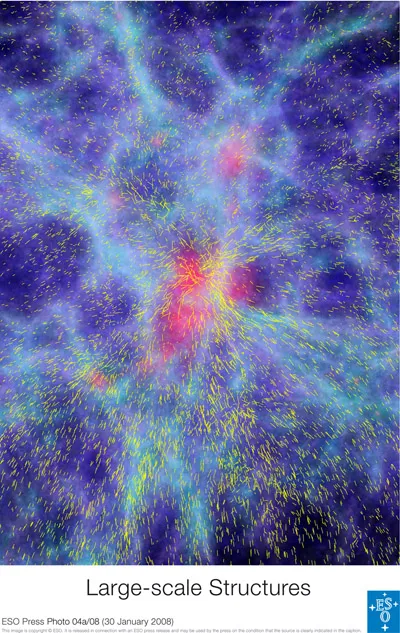
Image of a computer simulation of the formation of large-scale structures in the Universe, showing a portion of 100 million light-years and the resulting coherent motions of galaxies flowing towards the greatest concentration of mass in the center. The image corresponds to an epoch about 10 billion years ago in time. The color scale represents the mass density, with the highest density regions painted in red and the lowest in black. The small yellow lines describe the intensity and direction of the galaxies' velocities. Like compass needles, they map the clustering pattern and measure the growth rate of the central structure. This depends on the subtle balance between dark matter, dark energy, and the expansion of the Universe. Astronomers can measure this effect using large surveys of galaxies at different epochs in time, as the new research shows.
Credit: Klaus Dolag and the VVDS team
Note: The ESO press release also includes an animation in QuickTime format.