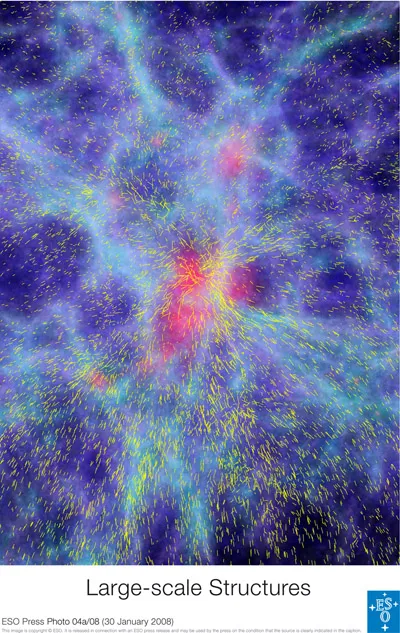
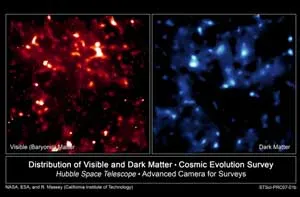
Cosmologists have performed a series of computational simulations of the Universe that could help understand dark energy.
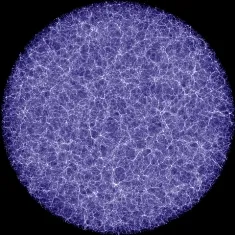
The simulations were performed by the Institute for Computational Cosmology (ICC) at Durham University. The findings, published in Monthly Notices of the Royal Astronomical Society, will also provide vital data for the design of a proposed mission, called SPACE (SPectroscopic All-sky Cosmic Explorer) which could unveil the nature of dark energy.
The simulations, which took 11 days on the Cosmology Machine (COSMA) computer, focused on the small waves in the distribution of matter in the Universe made from sound waves a few hundred thousand years after the Big Bang.
The waves are delicate and some have been destroyed over the subsequent 13 billion years of the Universe, but the simulations showed they survived under certain conditions.
By changing the nature of dark energy in the simulations, the researchers discovered that the waves appeared to change in length, which could be used for measuring dark energy.
Carlos Frenk, director of ICC says: "The waves are a 'gold standard'. By comparing the size of the measured waves with the standard we can know how much the Universe expanded and from there decipher the properties of dark energy. Astronomers are stuck with the Universe we live in. However, the simulations allow us to experiment with what might have happened if there had been more or less dark energy in the Universe."
In the next 5 to 10 years a number of experiments are planned to explore this energy. The Durham simulation demonstrated the feasibility of the SPACE mission proposed to ESA for its Cosmic Vision program.
SPACE, led by the University of Bologna in Italy will be evaluated by the European Agency and, if successful, would be launched in 2017.
Researcher Andrea Cimatti, from the Univ. of Bologna says: "Thanks to the ICC simulations it is possible to predict what SPACE could observe and plan how to develop the mission parameters to obtain a three-dimensional map of the Universe and compare it with the predictions of the simulations. Thanks to the comparison, it will be possible to unveil the nature of dark energy and understand how the structures in the Universe were built and evolved over cosmic time."
Sources and related links
- *EurekAlert:Supercomputer could throw light on 'mysterious' dark energy
- *Univ. Durham:Super-computer could throw light on “mysterious” dark energy
- *R. E. Angulo, C. M. Baugh, C. S. Frenk, C. G. Lacey (2008)
The detectability of baryonic acoustic oscillations in future galaxy surveys
Monthly Notices of the Royal Astronomical Society 383 (2), 755–776.
doi:10.1111/j.1365-2966.2007.12587.x
About the images
Credit: Durham University.