A new and controversial study claims to have detected remnants of cosmic strings in the radiation of the early Universe. If confirmed, it would open a window to the extreme physics of the first instants of the cosmos.
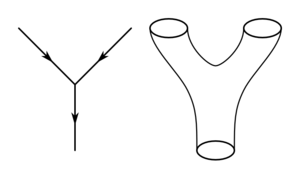
The string theory is a fundamental model of physics that basically states that all building blocks of matter are actually expressions of a basic one-dimensional extended object called a "string" or "filament".
The theory evolved towards the concept of supersymmetry. The theory has five different versions until in 1995 Edward Witten conjectured that the five different superstring theories are limiting cases of an unknown 11-dimensional theory called M-Theory.
The theory remains one of the possible candidates for the Grand Unified Theory, but with great theoretical and experimental difficulties that would allow its verification.
Now, a team of scientists says that traces of strings can be detected in the afterglow of the Big Bang. Led by Neil Bevis of Imperial College London, the team used the satellite WMAP (Wilkinson Microwave Anisotropy Probe) to observe the so-called cosmic microwave background radiation.
The team used computers to simulate what the background radiation would look like with and without strings and compared the results with WMAP observations. They found a better agreement when strings were included.
Although the study's authors are enthusiastic about the results, other scientists, such as Charles Bennett, chief scientist of the WMAP mission, believe that the preference for the string scenario is probably a statistical coincidence.
He also points out that the preference disappears when other observations are considered, such as the Hubble Space Telescope's measurement of the Universe's expansion rate.
It does not seem that the study will revolutionize physics. On the contrary, new, more precise observations are expected, for example with the Planck satellite, which would be launched this year.
Sources and related links
- *NewScientist:Cosmic strings observed in background radiation
- * Fitting Cosmic Microwave Background Data with Cosmic Strings and Inflation
Neil Bevis, Mark Hindmarsh, Martin Kunz, and Jon Urrestilla
Phys. Rev. Lett. 100, 021301 (2008)
About the images
What are interactions like in the sub-atomic world?: space-time lines like subatomic particles in the Standard Model (left) or Closed string without ends and in the shape of a circle as string theory claims (right)
Image by Maxim Razin on Wikipedia